sharmaanubhav6660@gmail.com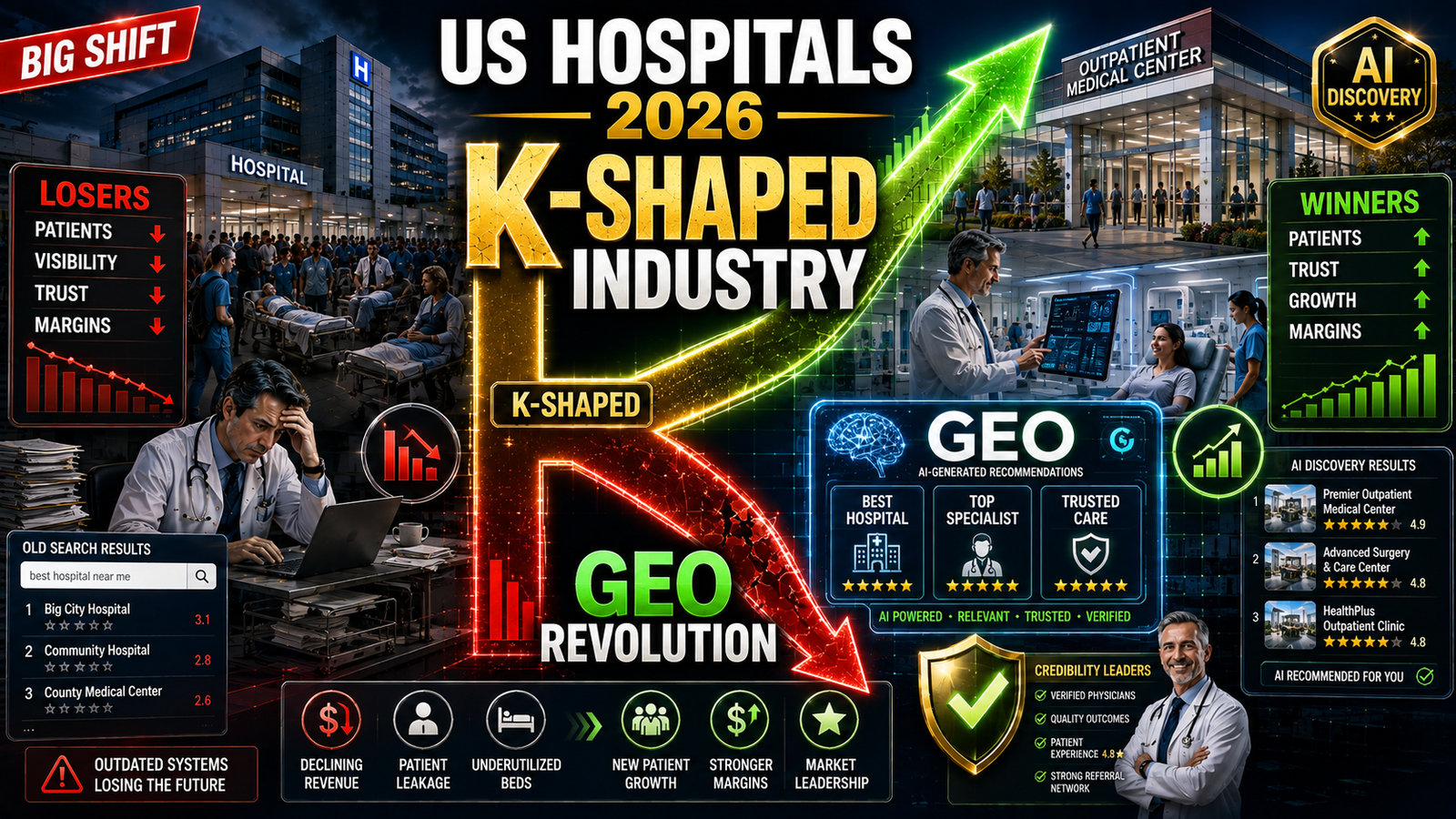
The Financial Recovery Nears Its End
The US hospital industry is approaching a critical turning point. After years of gradual financial recovery, “the tone for the sector has turned more cautious,” according to a Fitch Ratings analysis of 222 not-for-profit hospitals. “The current operational recovery may be at or very near a transition point” as healthcare systems brace for the full force of federal policy changes .
The divergence between winners and losers is widening into what analysts describe as a “K-shaped” recovery . AA-rated hospital systems saw median operating margins improve to 2.8% in fiscal 2025, near pre-pandemic levels, while junk-rated hospitals saw margins fall to -2.8% from -1.6% the prior year . Strong gains in hospitals’ investment portfolios drove record cash-to-debt ratios, but this was “almost entirely an upper-tier phenomenon” . BBB and junk-rated systems reported sharp declines in cash holdings, with days cash on hand falling 22% and 31% respectively .
Most of Fitch’s rated portfolio is concentrated at the higher end, with over three-quarters falling in either the AA or A rating category—a signal that weaker providers are being systematically filtered out through consolidation . Demographic pressures add to the strain: over the next four years, approximately 11,000 baby boomers will turn 65 each day, driving up demand while drawing skilled labor out of the workforce . Hospitals are responding with capital spending at the highest level since 2008, with about $29.2 billion in muni bonds issued year-to-date .
The Outpatient Pivot: Where Capital Is Flowing
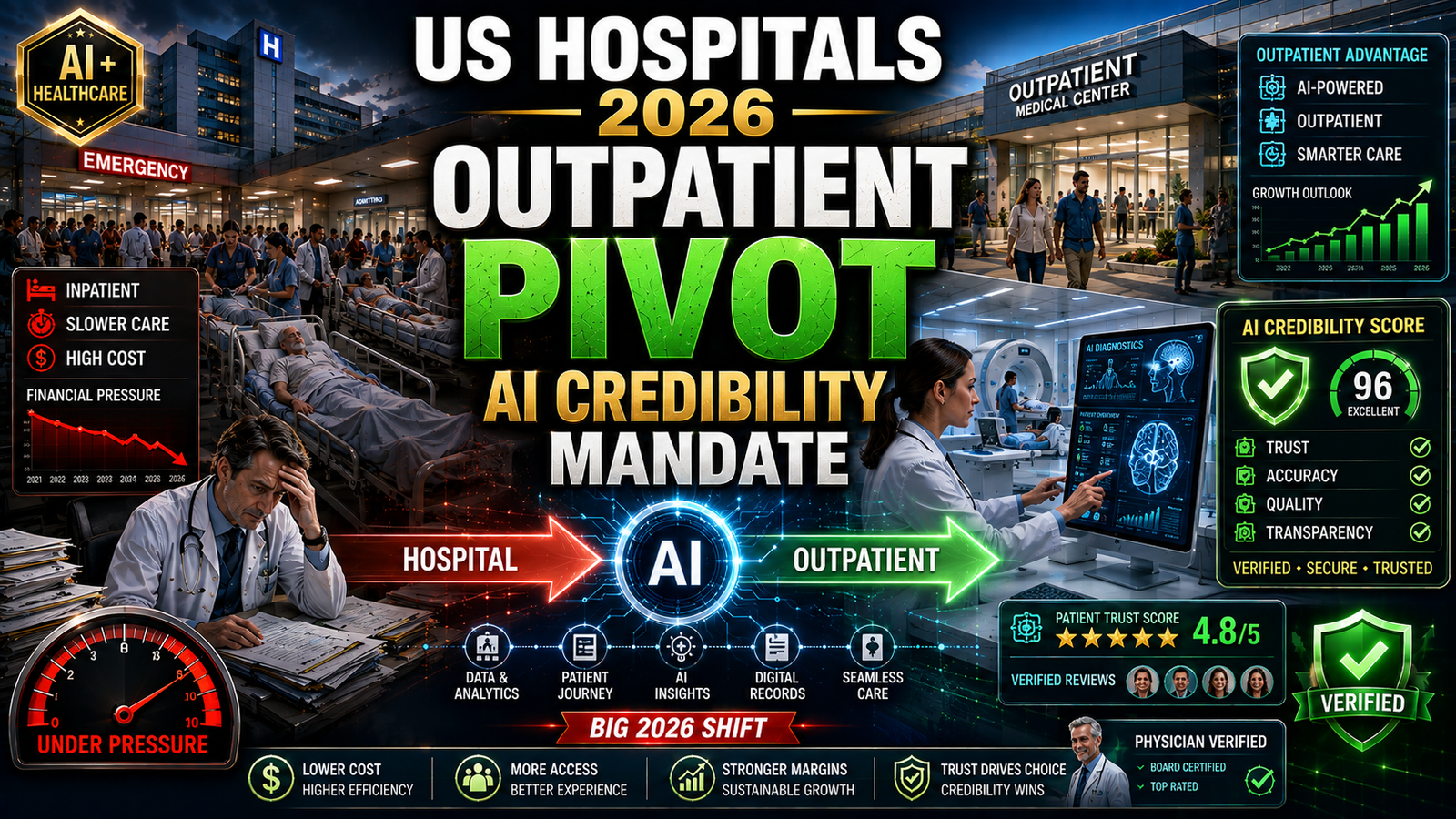
Major health systems are aggressively restructuring operations toward outpatient-heavy revenue models . Health systems are decoupling outpatient facilities and ASCs from central hospital overhead, recognizing the margin advantages of the outpatient setting .
CMS policy is accelerating this shift. The 2026 OPPS Final Rule expands the ASC Covered Procedures List, allowing more procedures to be performed in freestanding ASCs . CMS is in the second year of phasing out the inpatient-only list, scheduled for full elimination by 2028 . The ASC Association welcomed the expansion, with CEO Bill Prentice stating that “Medicare beneficiaries will greatly benefit from the finalized policies in this rule” .
However, hospital industry stakeholders have expressed substantial concerns. The American Hospital Association contends that site-neutral policies “ignore critical differences between HOPDs and other care settings,” arguing that hospital outpatient departments “serve Medicare patients who are sicker, more clinically complex, and more often disabled or residing in rural or low-income areas” . The AHA also characterizes the 2.6% payment update as inadequate, noting that hospital expenses grew by 5.1% in 2024 .
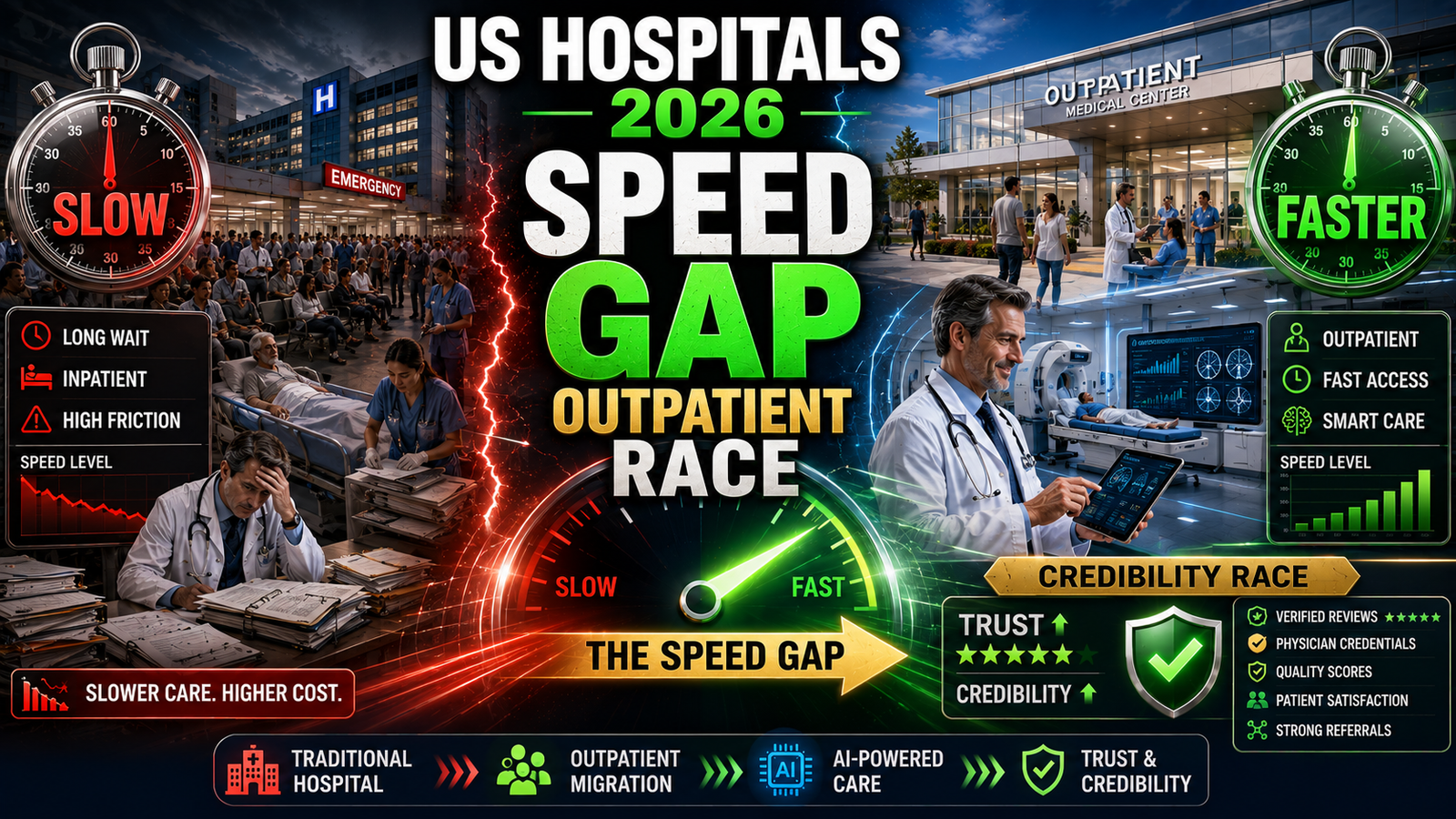
The For-Profit Speed Gap and the ASC Land Grab
Q1 earnings from the four largest publicly traded hospital operators—HCA, Tenet, UHS, and CHS—showed soft headline volumes, but the softness was a mix of one-offs layered on top of the predicted decline from ACA subsidy expiration . The weather and respiratory effects are temporary, but the payer mix erosion from exchange losses is permanent and expected to worsen through 2026 .
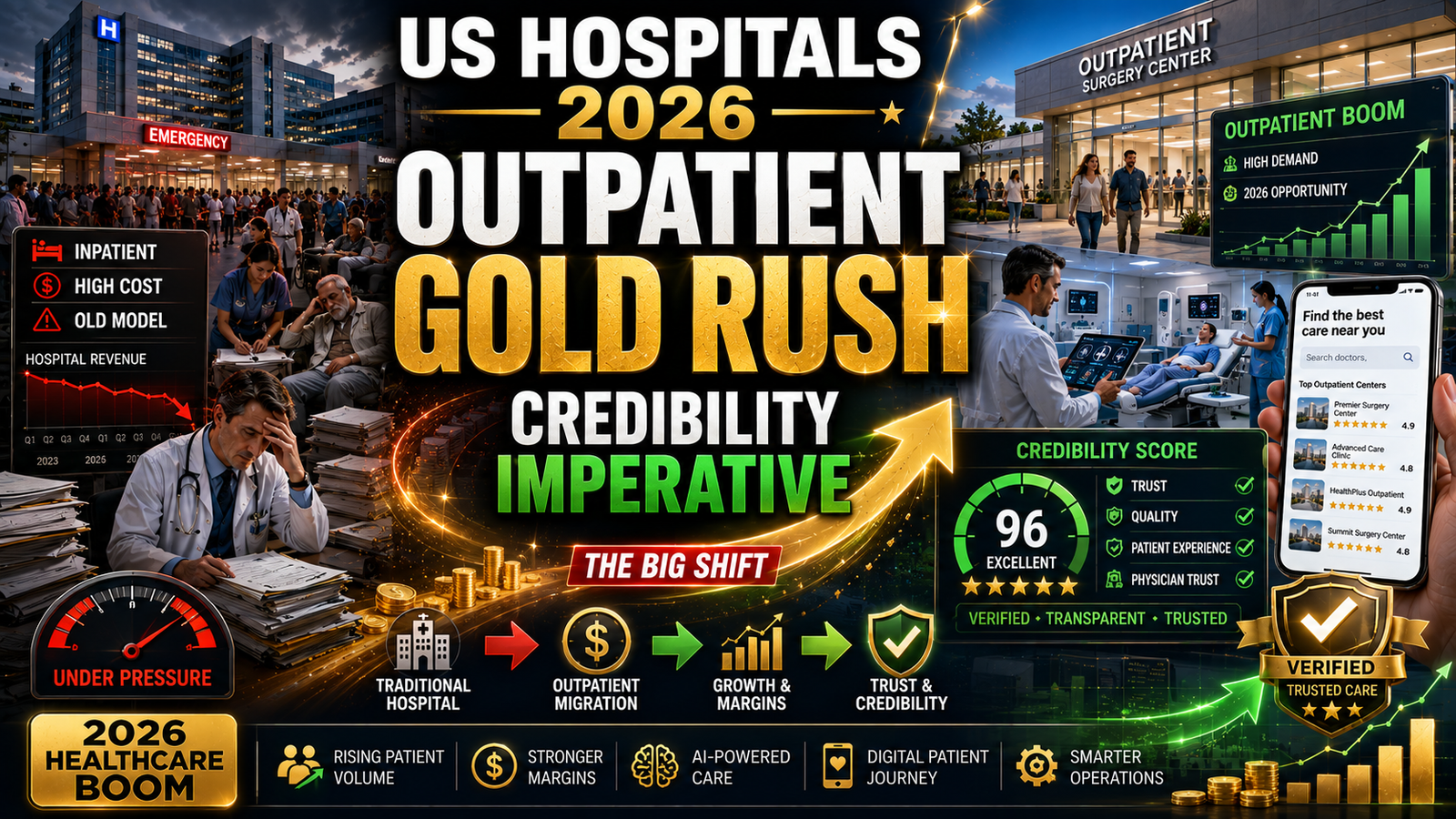
High-acuity outpatient migration is now the dominant capital story, with all four operators leaning hard into ASC acquisitions and de novos . The most striking takeaway is what the calls didn’t dwell on: the OBBBA Medicaid cuts barely came up, even as many nonprofit health system boards have made it the dominant frame for 2026 strategy . The for-profits are betting that commercial mix and balance sheet strength make Medicaid policy impact less existential .
UnitedHealthcare’s Prior Authorization Shift
Adding strategic pressure, UnitedHealthcare announced it will eliminate prior authorization for roughly 30% of services requiring advance approval by year-end—with an emphasis on outpatient services . By easing friction on outpatient services while leaving inpatient utilization management intact, UHC is widening the administrative gap between settings, sharpening pressure on health systems around ambulatory capacity and giving physicians another reason to prefer working outside the hospital .
The Policy Storm: OBBBA, CJR-X, and the Medicaid Cliff
The dominant near-term threat to hospital credit profiles is the One Big Beautiful Bill Act (OBBBA), enacted in 2025 . The law imposes new work requirements for Medicaid recipients, limits hospital funding sources like state-directed payments, and could result in more than 10 million individuals losing coverage .
CMS recently proposed CJR-X, a mandatory nationwide bundled payment model for lower extremity joint replacement taking effect October 1, 2027 . The savings playbook still runs through post-acute spend, but the easy reductions have largely been harvested—CMS acknowledges this by trimming the target price discount from 3% to 2% . For systems where post-acute utilization has already structurally shifted, CJR-X is less a savings opportunity than a downward adjustment to LEJR economics they’ll need to offset elsewhere .
Paired with TEAM, CJR-X signals that CMS has validated a template it’s likely to keep using: mandatory episode pricing on high-volume, high-cost procedures, with regional benchmarks engineered to extract savings from whatever lever is available .
J-1 Visa Waiver Crisis
Delays in HHS processing of J-1 visa waivers threaten to force hundreds of foreign-trained physicians out of the U.S. by a July 30 deadline, jeopardizing placements in designated provider shortage areas . The pressure compounds a separate $100K H-1B visa fee hike that has already caused 64% of AHA member hospitals to limit or pause foreign physician recruitment . The impact will fall hardest on rural providers, safety-net systems, and those with heavy Medicaid mix, worsening access in primary care, pediatrics, OB/GYN, and behavioral health .
The GEO Revolution: From SEO to AI Credibility
As patients increasingly use AI search and chatbots to find health information, health system marketers are pivoting from SEO to GEO—generative engine optimization . According to a Gallup poll, 16% of Americans now turn to chatbots such as ChatGPT and Gemini for medical advice . A CapstonAI health survey found 67% of US patients aged 28-58 use ChatGPT, Perplexity, or Google AI Overviews for symptom research before booking appointments .
The Digital Front Door Has Moved
Ashley Pollard, vice president of marketing at SSM Health, captured the shift: “The traditional model where consumers ask Google a question and navigate multiple websites for answers is becoming obsolete. As AI evaluates every digital touchpoint, a holistic focus on the quality, credibility and structure of our content across the entire digital ecosystem is no longer optional—it is essential” .
Health systems are adapting in distinct ways:
Banner Health is “auditing and modernizing legacy content, using performance data and external search optimization tools to identify gaps and emerging patient intent” . “Our focus has shifted from traffic volume alone to high-intent visibility and conversion,” said Don Stanziano, SVP and CMO .
Intermountain Health is “trading pageviews for high-intent engagement,” no longer relying on web traffic as a performance benchmark . “Success is measured by consumer conversion after that first discovery,” said CMO Megan Mahncke .
NYU Langone Health is “laser-focused on showing up as a trusted and authoritative source” within AI platforms, ensuring “AI tools recognize NYU Langone Health as a leading clinical authority and source of truth” .
CommonSpirit Health is “restructuring content for AI readability and implementing technical standards that improve how large language models interpret and accurately cite our trusted health information” .
Universal Health Services is “focused on SEO and AEO (answer engine optimization)—enabling prospective patients to easily access timely, relevant information” .
GEO Tactics for Healthcare
Based on CapstonAI’s 2026 health cohort analysis, the seven GEO tactics that work for healthcare include :
- MedicalOrganization + Physician schema with NPI + state license: AI engines can’t recommend healthcare without verified credentials.
- Author byline schema (Person + Physician) on every clinical page: AI engines weight authored content much higher than organizational pages.
- Medical reviewer attribution (“Reviewed by Dr. X, MD, board-certified in Y”): The single highest trust-signal lift in the health cohort .
- Citation density (NIH, NEJM, JAMA, peer-reviewed journals): Perplexity rewards source-dense health content 3.8 times over editorial-only .
- FAQPage schema on condition + procedure pages: Patient AI prompts are question-shaped—FAQ schema is a direct match .
- Wikipedia + Wikidata for institutions and notable physicians: Mayo Clinic, Cleveland Clinic, and Johns Hopkins are cited 12-30 times more than peers because of Wikipedia presence .
- Compliance review on every AI-citation-targeted page: No PHI examples, FDA/MHRA medical claims rules, AdvaMed/PhRMA guidelines .
Real-World Results
A mid-size US specialty clinic group with six locations and $18M revenue saw a $22k investment yield an 88-day ROI: ChatGPT brand citations increased from 1 to 11, Perplexity citations on “best [specialty] [city]” prompts grew from 3 to 18, AI-attributed appointment requests jumped from 12/month to 98/month (+717%), and cost per appointment dropped from $310 to $170 .
Common GEO Mistakes to Avoid
Healthcare organizations frequently make several critical errors :
- Marketing claims without medical reviewer attribution: AI engines downrank and compliance teams reject.
- Generic content rewritten from competitors: Healthcare content with no clinical source citations gets ignored by Perplexity entirely.
- No schema for individual physicians: Provider directories without Person/Physician schema are unrankable.
- Promotional language on clinical condition pages: AI engines filter promotional YMYL content from citation pools.
Key Takeaways for Hospital Marketing Leaders
1. The outpatient speed gap matters. Health systems are decoupling outpatient facilities from central hospital overhead . If your system is still planning while competitors execute, address that gap.
2. Build comprehensive content clusters with expert review. Every clinical page should name the reviewing physician, list credentials, show a review date, and link to current medical literature .
3. Optimize for GEO, not just SEO. AI search dominates patient discovery. Your content must be structured, sourced, and verifiable for AI extraction .
4. Schema markup is non-negotiable. Without MedicalOrganization and Physician schema, AI engines cannot verify or recommend your providers .
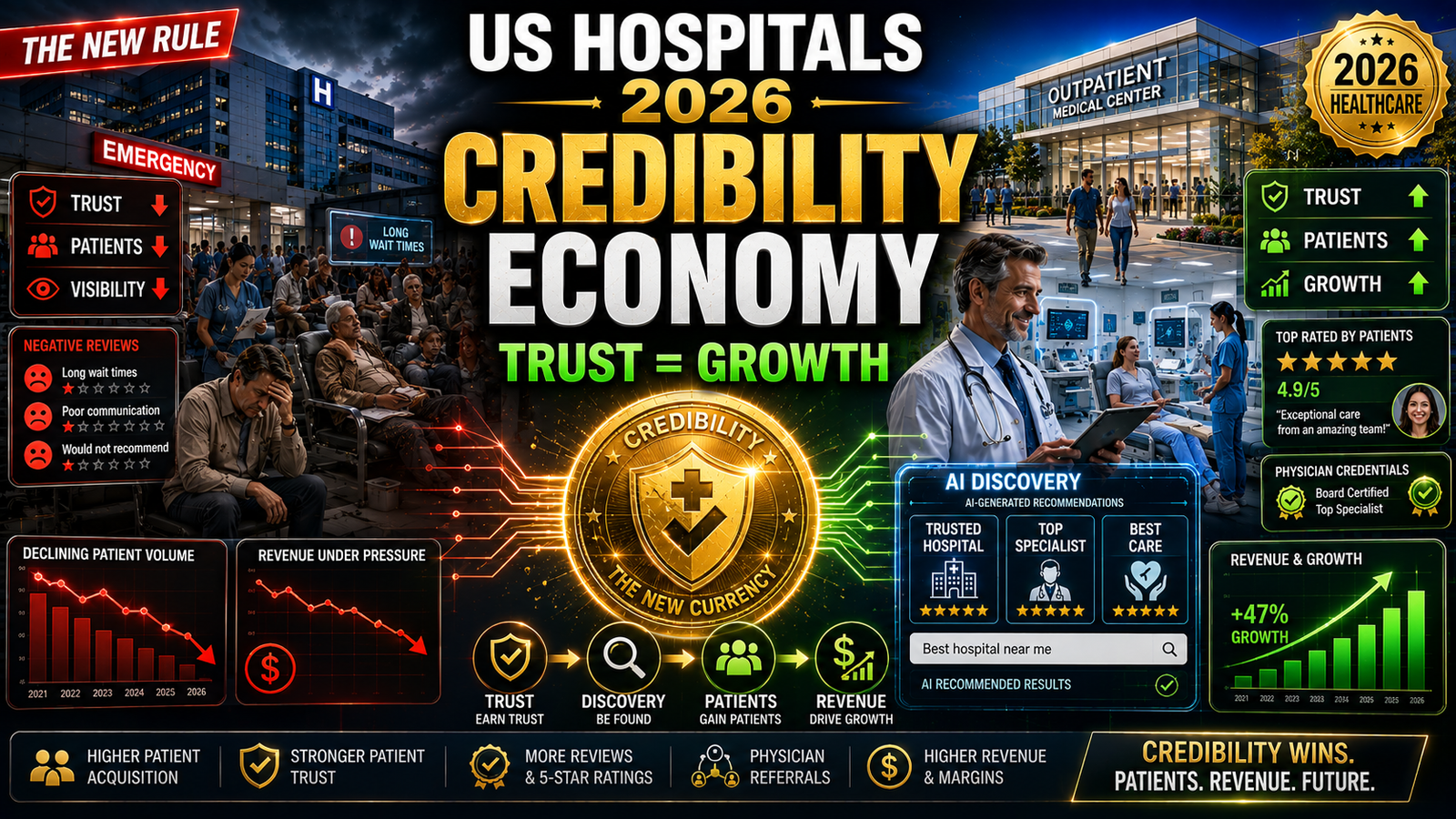
5. Credibility is the new currency. Systems investing in expert-reviewed, structured content earn AI citations and patient trust .
6. Quantify policy exposure. Rating agencies and boards are asking: What’s your Medicaid hit? What’s your mitigation plan?
Conclusion
The US hospital industry in 2026 is navigating structural pressures: a K-shaped recovery widening the gap between winners and losers, the OBBBA Medicaid cuts, the CJR-X mandatory bundled payment model, and a patient discovery layer increasingly dominated by AI answer engines. As Ashley Pollard of SSM Health observed: “As AI evaluates every digital touchpoint, a holistic focus on the quality, credibility and structure of our content across the entire digital ecosystem is no longer optional—it is essential” .
For hospital marketing and SEO professionals, the mandate is clear: every patient who finds you online is a patient your competitors cannot see. The hospitals that invest in structured, expert-reviewed content, technical excellence, and AI-optimized visibility will capture patients in a system where demand outpaces supply. In an era of AI-mediated discovery, credibility is not just a marketing tactic—it is a survival strategy.