sharmaanubhav6660@gmail.com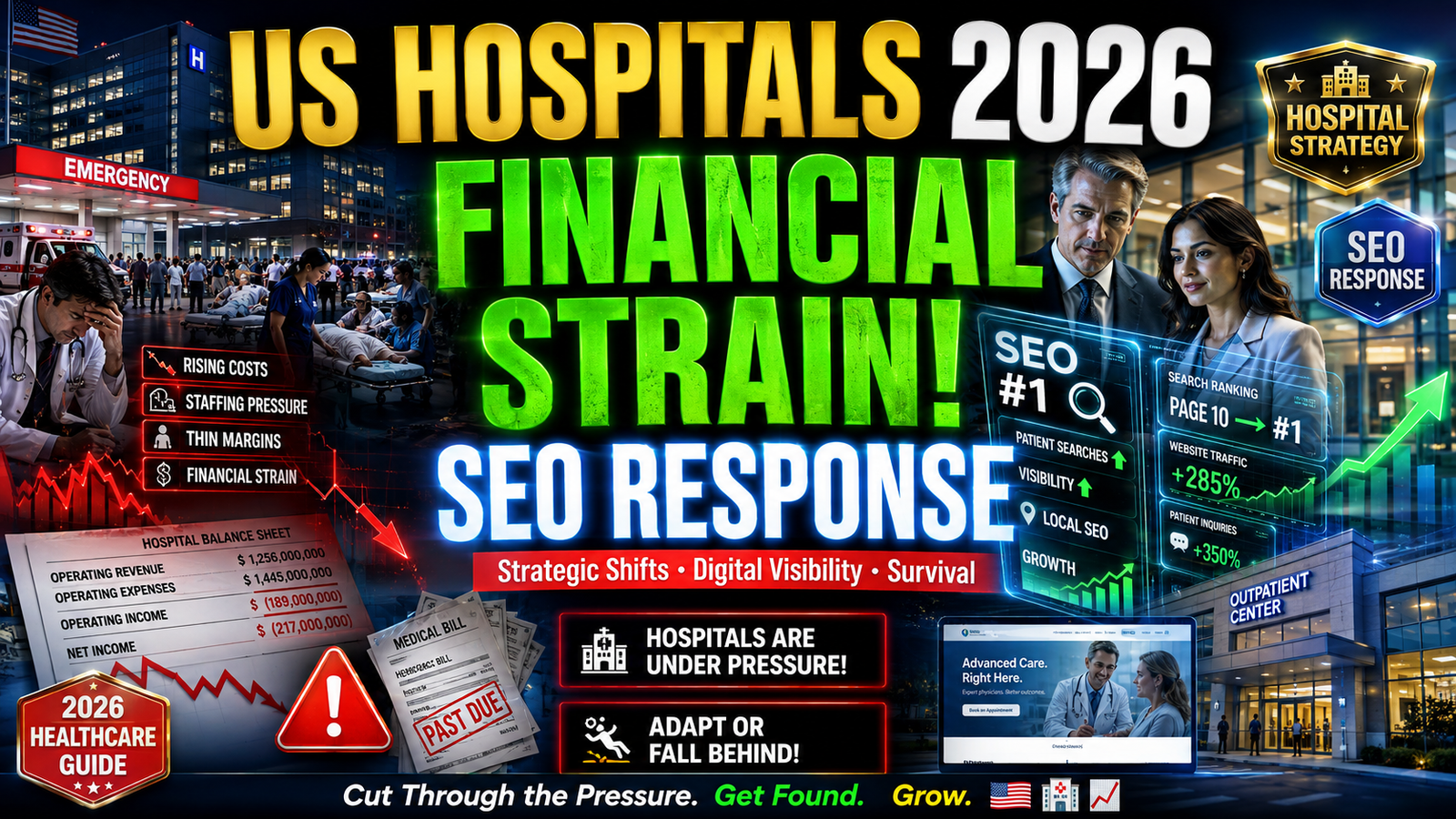
The K-Shaped Recovery: A Two-Tiered Hospital Sector
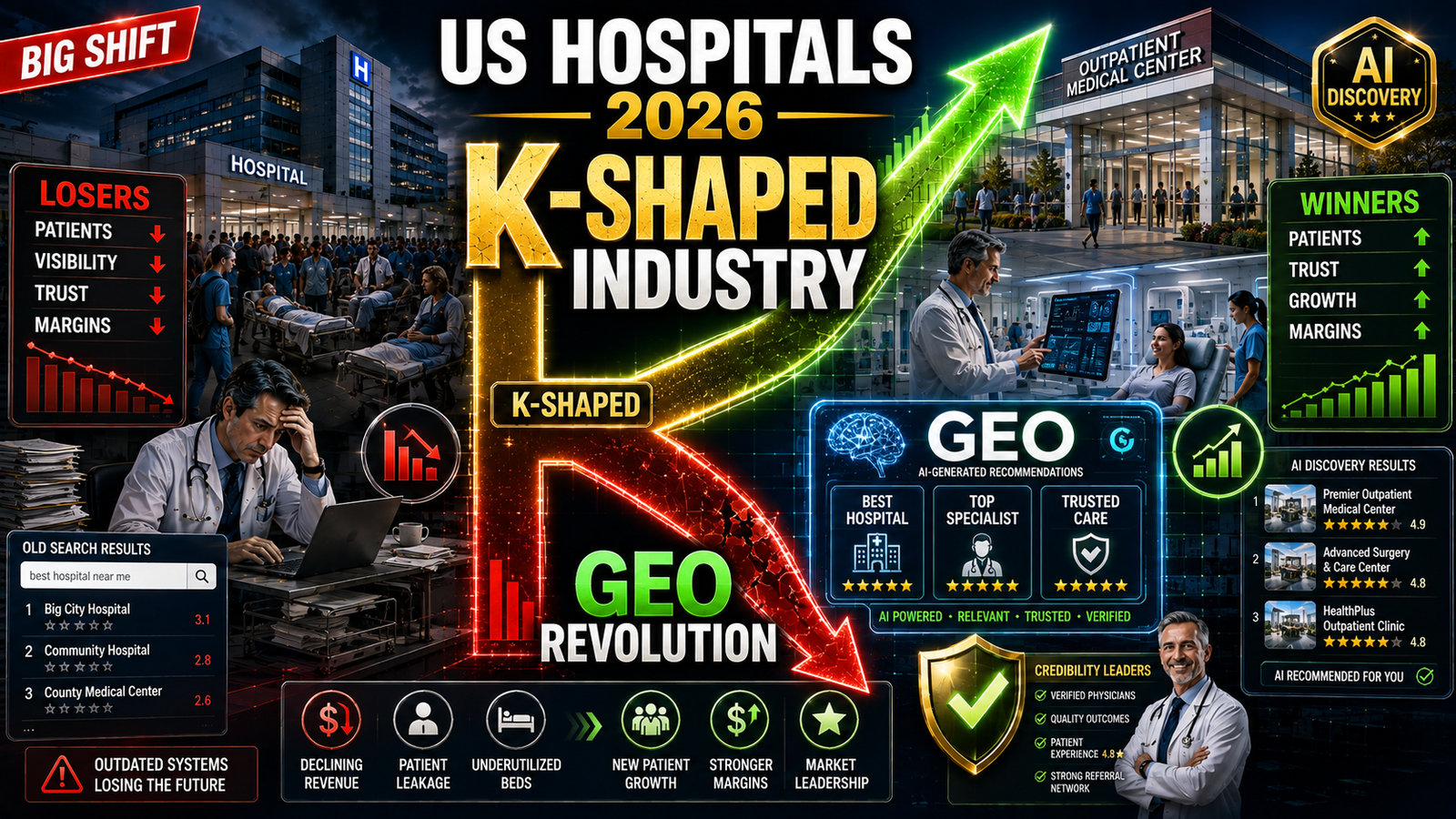
The US hospital industry in 2026 is experiencing a divergence that analysts describe as a “K-shaped” recovery—where financially strong systems pull ahead while weaker institutions decline. The numbers tell a stark story: AA-rated hospital systems saw median operating margins improve to 2.8% in fiscal 2025, while junk-rated hospitals saw margins fall to -2.8% from -1.6% the prior year . Record cash-to-debt ratios were driven by investment gains that “were almost entirely an upper-tier phenomenon” .
For hospital marketers, this divergence creates existential stakes. Every patient acquired through digital channels is a patient that struggling competitors cannot capture. SEO has shifted from a growth tactic to a survival imperative for weaker systems.
The Financial Picture: Broad Revenue, Narrow Margins
Nationally, US hospital net operating revenue rose 5% per calendar day in Q1 2026 compared to the previous year, with gross operating revenue growing 7% . The clear driver is outpatient care:
- Outpatient revenue grew 8% nationally, outpacing inpatient revenue (4%) in every region and every bed-size category except hospitals with 0–25 beds .
- Western hospitals led, with outpatient revenue surging 13% .
- Hospitals with 200–299 beds led all size segments, posting 10% outpatient revenue growth .
The gap between gross and net revenue reflects persistent cost pressures. Non-labor expenses jumped 7% monthly and yearly on a per-calendar-day basis, with supply costs up 5% and purchased service expenses up 9% . Operating margins remain under duress, with the year-to-date operating margin index at 1.9%, considerably below the 3.7% margin posted at the end of 2025 .
The Outpatient Imperative: Where the Money Is
Outpatient care is not just growing—it is reshaping hospital strategy. Health systems are asking: “Where can I get the best return when I invest my capital?” The answer increasingly is the ambulatory and outpatient space because “it’s far cheaper to build and operate there, with a much better return” .
The acquisition data reflects this urgency. Physician medical groups accounted for a record 46% of all healthcare transactions in early 2026, and ASCs (Ambulatory Surgery Centers) are the crown jewels of this acquisition spree.
The for-profit operator view: The big four for-profit hospital operators posted a common thread in Q2 2026—softened outpatient and ASC volumes, though pricing offset much of the impact. Tenet Healthcare’s USPI posted net operating revenues of $1.39 billion, up 9.3% year-over-year, despite same-facility surgical cases falling 1.2% . Revenue per case rose 6.3%, driven by higher acuity and favorable service mix .
At Community Health Systems, CEO Kevin Hammons noted that procedural softness is concentrated in elective specialties, citing “orthopedics being the largest decline,” while surgery centers are picking up volume, though “lower acuity surgeries and not the orthopedic and some of the cardiac procedures” the company would normally expect . This suggests some volume is migrating to ASCs rather than disappearing—and some patients are delaying follow-on procedures for economic reasons tied to copays and deductibles .
The Policy Storm: $1 Trillion in Medicaid Cuts
The dominant threat to hospital credit profiles is the One Big Beautiful Bill Act (H.R. 1), which became law in 2025. The bill is expected to cut nearly $1 trillion from Medicaid, the Children’s Health Insurance Program, and the Affordable Care Act over the next decade .
Direct revenue impacts will stem from reductions to provider tax contributions and state-directed payments (SDPs), starting in FY28 . Credit rating agencies are now asking health systems to quantify their exposure: “What’s your hit, what’s your exposure? It’s $10 million, it’s $100 million, it’s a billion dollars. Give me a number, and then give me those mitigants” .
The impact could be devastating for vulnerable hospitals. National Nurses United projects that 602 financially vulnerable hospitals could see their combined deficit grow 50% to 75% under the combined weight of Medicare sequestration, Medicaid cuts, and the expiration of enhanced ACA marketplace subsidies . Those 602 hospitals already carry a combined $10.16 billion deficit, and the new cuts could add $5.21 billion to $7.72 billion in a single year once fully phased in .
AAP leaders have warned the changes will have “an especially devastating impact on children’s hospitals, clinicians and hospitals in rural areas, and pediatricians already operating on razor-thin margins” . The proposed rule goes beyond the statutory language Congress approved, creating additional uncertainty .
The Outpatient Shift Tradeoff: Volume vs. Acuity
As more care moves to outpatient settings, hospitals face a concentration of high-acuity patients on the inpatient side. The report notes that as care migrates, “hospitals also face revenue dilution” and a higher concentration of complex patients .
Volume trends reinforce this dynamic:
- Discharges per calendar day fell 2%
- Adjusted discharges rose 2%
- Adjusted patient days declined 1%
- Average length of stay dropped 4%
- Emergency department visits decreased 5%
Erik Swanson, managing director at Kaufman Hall, summarized: “Hospitals are off to a relatively soft start in 2026. Outpatient care strategies offer a potential path forward, though hospitals must manage both revenue dilution and a greater concentration of high-acuity patients as a result” .
SEO and GEO Strategy for 2026
Content Clusters and Authority Pathways
Content clusters—a pillar page supported by related subtopic pages—mirror how Google’s AI systems understand conditions, treatments, and patient journeys . A joint replacement cluster might include the pillar page, then branch into preparation, surgery types, recovery timelines, physical therapy, and long-term outcomes—all interconnected and demonstrating comprehensive expertise .
Key priority: Before publishing another article, hospitals need a content map. Which specialty areas do you want to own in search? Which patient questions are you equipped to answer better than anyone else in your market?
The March 2026 Google core update further penalized thin content spread across disconnected topics. Hospitals with coherent content clusters have held or improved their positions, while those publishing broadly without a content architecture have not .
Technical SEO: The Non-Negotiable Foundation
Siteimprove emphasizes three technical priorities :
- Accessibility checks: Heading hierarchy, color contrast, missing alt text, keyboard navigation. Older adults (a huge portion of healthcare searchers) abandon sites that don’t work with screen readers or keyboard controls. Google penalizes inaccessible pages .
- Technical SEO validation: Broken links, orphaned pages, missing meta descriptions, canonical tags, crawlability, and mobile usability .
- Brand consistency: Consistent tone, legal disclaimers, and brand terminology across departments .
GEO (Generative Engine Optimization)
AI search visits grew 42.8% year-over-year, rising from 15.6 billion in Q1 2025 to 27.4 billion in Q1 2026 . Health systems that rely only on classic SEO are now optimizing for a channel that grows far slower than the one patients are adopting .
Key GEO tactics :
- Expert-reviewed content: Every clinical page should name the reviewing physician, list credentials, show a review date, and link to current medical literature. Adding statistics increased AI visibility by 22%, and adding quotations raised it by 37% .
- Place answers high on the page: 44.2% of ChatGPT citations come from the first 30% of page text .
- Use structured tables: Tables get extracted by LLMs at 81% versus 23% for prose .
- Cover real patient questions: Symptoms, treatment options, recovery timelines, costs, and insurance coverage .
- Freshness matters: 65% of AI bot hits target content published within the past year .
Entity and Authority Signals
Strengthen brand, clinician, and location entities so answer engines pull the right facts and attribute them to you . The technical foundation includes schema markup, clean HTML that AI models can parse, fact highlights, and structured links and references .
Real-world results: A medical case study showed AI visibility improved from 18% to 44% (+26%), SOV (Search Occupancy Volume) increased 133%, brand citations rose 157%, and hallucination rates dropped from 22% to 9% over a 5-month optimization period .
Conclusion: Visibility Is Survival
The US hospital industry in 2026 is navigating unprecedented pressures: structural shifts to outpatient care, $1 trillion in Medicaid cuts, a K-shaped recovery that widens the gap between winners and losers, and a patient discovery layer that is increasingly dominated by AI answer engines.
For hospital marketing and SEO professionals, the mandate is clear:
- Build comprehensive content clusters around priority specialties—cardiology, oncology, orthopedics require 15-25+ pages each.
- Optimize every location and physician page—patients search for “Dr. Name City” and “[specialty] near me.”
- Invest in technical SEO—accessibility, schema markup, and internal linking are non-negotiable.
- Prepare for GEO—your content must be referenced and summarized accurately by AI answer engines.
- Diversify your content portfolio—don’t rely on one high-performing article. Build multiple traffic drivers.
The hospitals that invest in robust, patient-centered content will capture patients that their competitors cannot see. In a system where 602 hospitals already carry a combined $10 billion deficit and policy cuts loom, visibility is not just a growth tactic—it is a survival strategy .