sharmaanubhav6660@gmail.com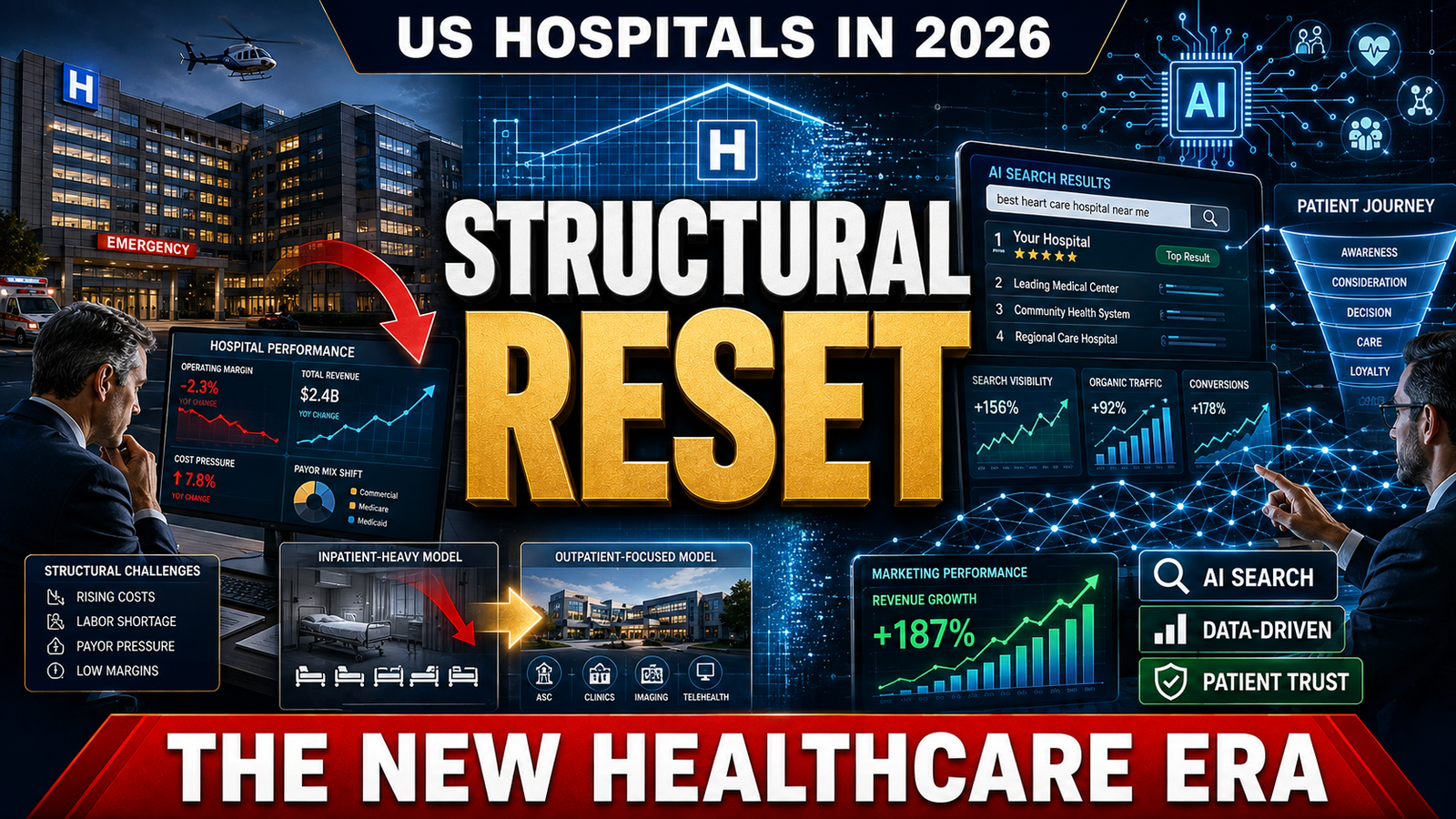
The End of the Recovery: A K-Shaped Hospital Sector
The US hospital industry is entering a period of fundamental reset. After years of gradual financial improvement, “the tone for the sector has turned more cautious,” according to a Fitch Ratings analysis of 222 not-for-profit hospitals and health systems. “The current operational recovery may be at or very near a transition point” as healthcare systems brace for the full force of federal policy changes .
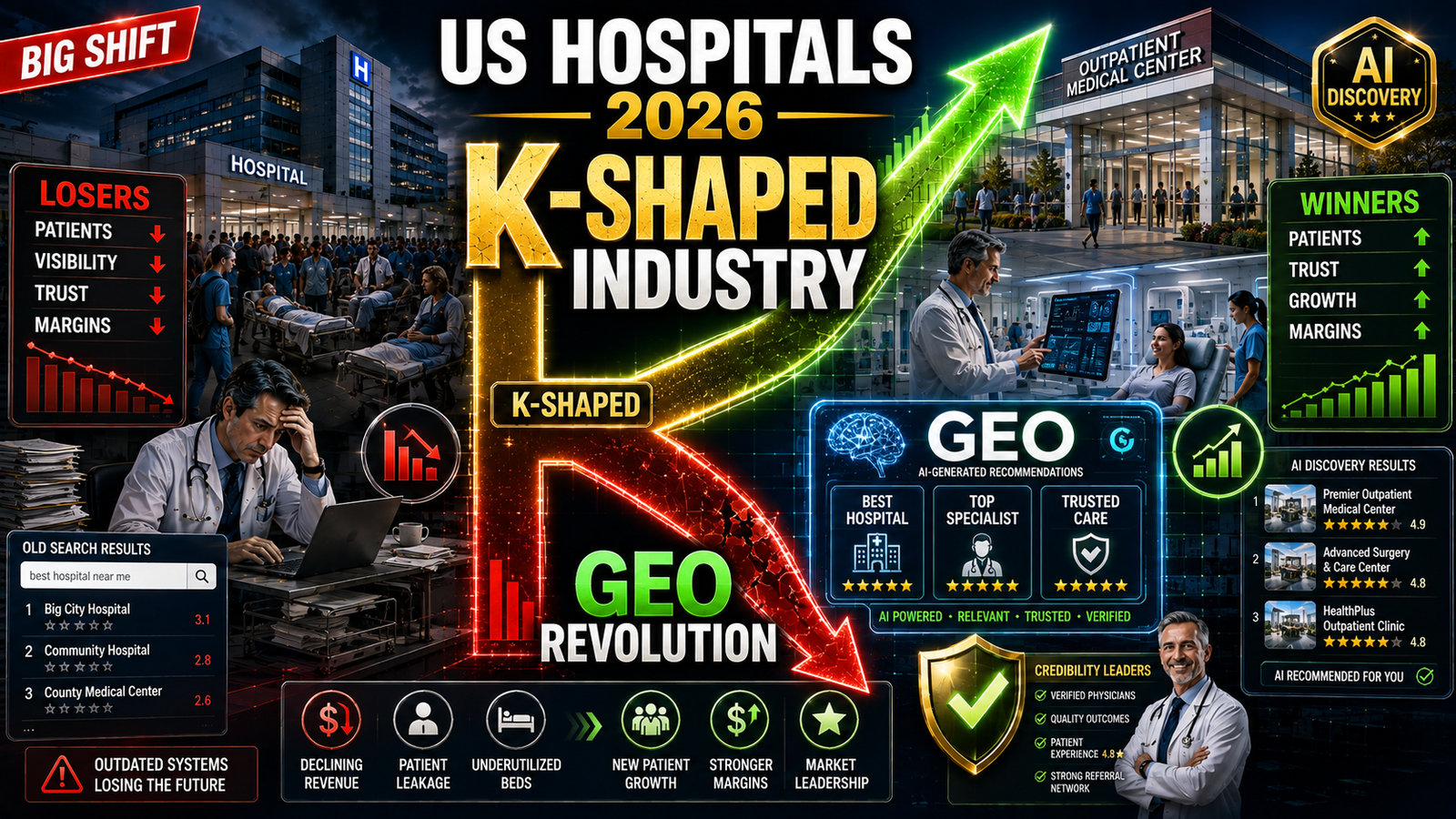
The data reveals a stark K-shaped divergence. AA-rated hospital systems saw median operating margins improve to 2.8% in fiscal 2025, near pre-pandemic levels, while junk-rated hospitals saw their margins fall to -2.8% from -1.6% the prior year . Strong gains in hospitals’ investment portfolios drove record cash-to-debt ratios, but this was “almost entirely an upper-tier phenomenon.” BBB and junk-rated systems reported sharp declines in cash holdings, with days cash on hand falling 22% and 31%, respectively .
This divergence is the result of decades of consolidation and the attrition of weaker credits. Fitch’s rated portfolio is concentrated at the higher end, with over three-quarters in AA or A categories—a signal that weaker providers are being systematically filtered out of the sector . The pre-existing strain is significant: 39% of US hospitals were already losing money in 2023, before new waves of funding cuts began taking effect .
The demographic wave adds further pressure. Over the next four years, approximately 11,000 baby boomers will turn 65 each day, simultaneously driving up demand for advanced medical care and drawing skilled labor out of the workforce . Capital spending has risen to the highest level since 2008 as hospitals prepare, with about $29.2 billion in muni bonds issued year-to-date .
The Outpatient Surge: 8% Growth and Structural Questions
The Q1 2026 data from more than 1,300 hospitals paints a picture of broad revenue growth with complicated undercurrents. Net operating revenue rose 5% per calendar day compared to the previous year, with gross operating revenue growing 7% .
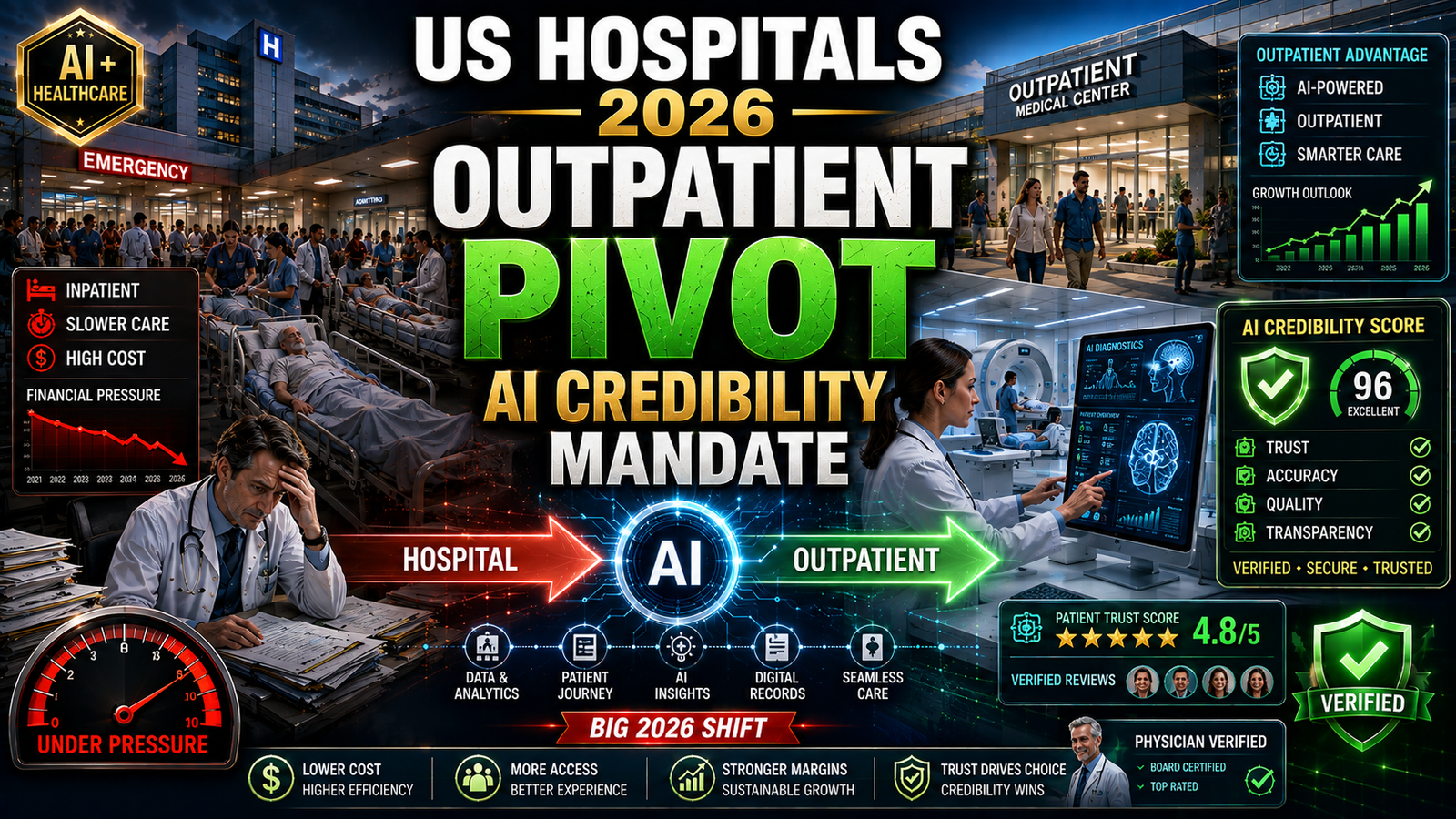
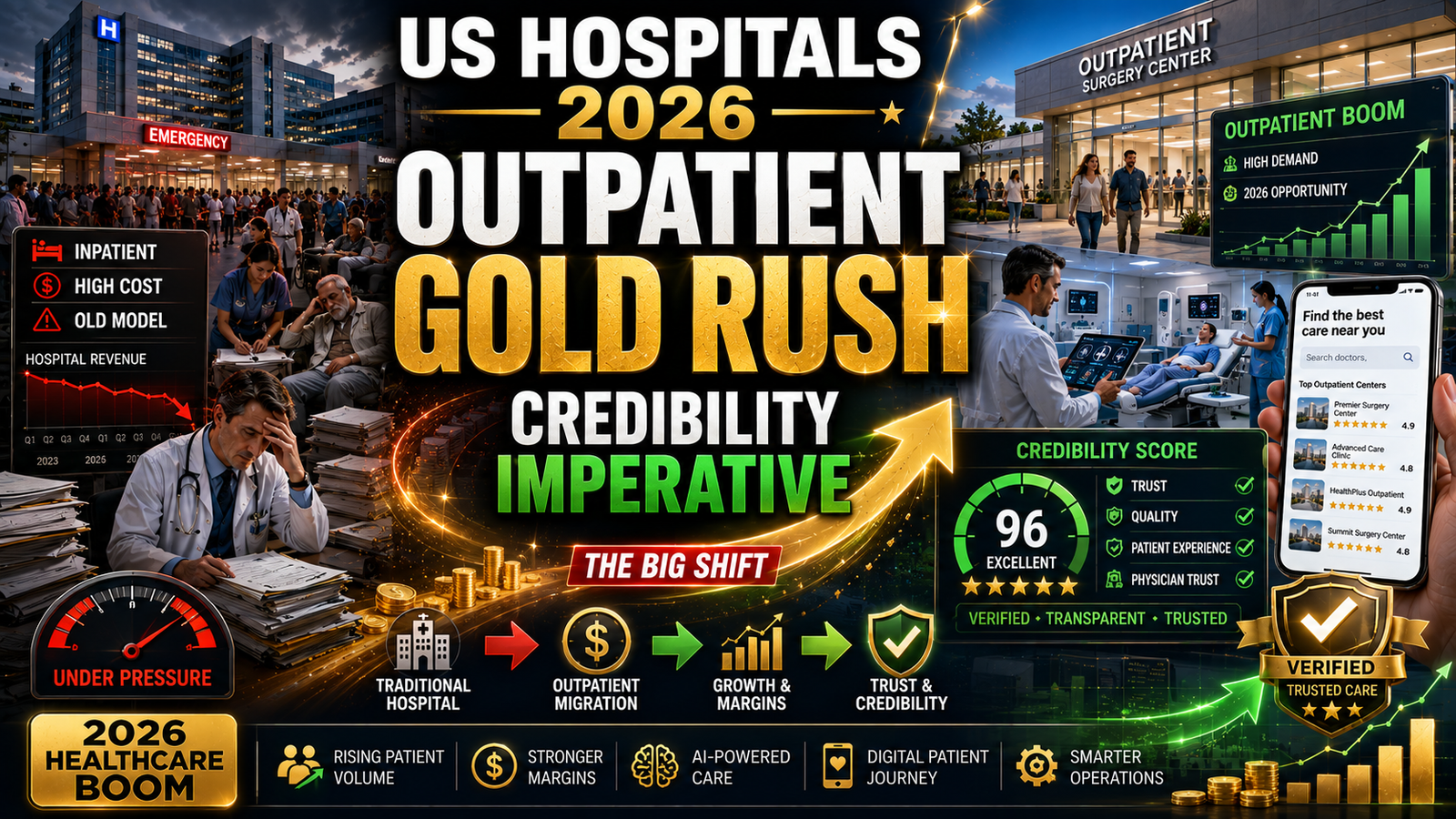
Outpatient care was the clear driver of revenue growth. Outpatient revenue grew 8% nationally, outpacing inpatient revenue (4%) in every region and nearly every bed-size category nationwide . The February data showed outpatient revenue surging 7% month-over-month and year-over-year .
Regional performance varied dramatically:
- Western hospitals led all regions, with outpatient revenue surging 13%
- Southern hospitals posted 9% outpatient revenue growth and the highest inpatient growth at 5%
- Midwest hospitals posted the most modest gains, with outpatient revenue up just 5%
Hospital size tells a similar story of divergence. Hospitals in the 200–299 bed range led all segments: net operating revenue up 8%, inpatient revenue up 7%, and outpatient revenue up 10% . The smallest hospitals (0–25 beds) recorded inpatient revenue declining 2%, even as outpatient revenue grew 4% .
However, the outpatient shift comes with tradeoffs. As more care moves to outpatient settings, hospitals face revenue dilution and a higher concentration of complex, high-acuity patients on the inpatient side . Volume trends reinforce this dynamic: discharges per calendar day fell 2%, adjusted patient days declined 1%, average length of stay dropped 4%, and emergency department visits decreased 5% .
Erik Swanson, managing director at Kaufman Hall, summarized the predicament: “Hospitals are off to a relatively soft start in 2026. Outpatient care strategies offer a potential path forward, though hospitals must manage both revenue dilution and a greater concentration of high-acuity patients as a result” . Hospital leaders at the Becker’s 16th Annual Meeting debated whether expanding outpatient access grows the overall revenue pie or cannibalizes inpatient volume—a strategic question with real financial consequences .
The Policy Storm: $1 Trillion in Medicaid Cuts
The dominant near-term threat to hospital credit profiles is the One Big Beautiful Bill Act (H.R. 1), which became law in 2025 . The law imposes new work requirements for Medicaid recipients, limits hospital funding sources like state-directed payments, and could result in more than 10 million individuals losing insurance coverage .
446 Hospitals at Risk
Public Citizen identified 446 at-risk hospitals—those heavily dependent on Medicaid revenue and operating at a loss in recent years—with at least one facility affected in 44 states and Washington, D.C. . About 60% of at-risk hospitals (267 facilities) are in urban areas, with Black and Latino communities likely to be hardest hit .
The specific impacts are devastating:
- Alameda Health System will lose more than $100 million annually by 2030 and has laid off nearly 300 employees
- Trinity Health projects $1.5 billion in losses and has already cut 10.5% of its billing staff, closing the maternity unit at one of its Georgia hospitals
Projected Losses
A Third Way analysis projects hospitals will collectively lose $16.4 billion in revenue in 2026, with total federal cuts across Medicaid, marketplace, and Medicare estimated at $661 billion over the next decade . The Congressional Budget Office estimates 11.8 million Americans will lose Medicaid coverage under new eligibility restrictions .
State-Directed Payment Cuts
CMS projects 39 state programs will spend more than $140 billion through state-directed payment arrangements in 2026, a funding channel now subject to new federal restrictions . Analysis found that capping these payments at Medicare rates would reduce Medicaid hospital revenue by more than 20% in 19 states . Children’s hospitals face particular exposure, with more than one-third of their Medicaid funding sourced from these payment arrangements .
The Human Toll
The consequences are already visible. Since July 2025, 302 clinics and hospitals have closed across 42 states, while nearly 10,000 healthcare workers in 31 states have lost their jobs . In June 2026 alone, 44 hospital closures, clinic closures, and service reductions occurred across 13 states, with 897 employees laid off . Deductibles for health insurance plans on the ACA marketplace have increased by an average of $1,027 this year alone .
The ASC Land Grab: Outpatient Capital Deployed at Pace
High-acuity outpatient migration is now the dominant capital story for all major operators. The buyer universe has never been more diverse: health systems, private equity, payers, and physician-owned platforms are all acquiring outpatient assets simultaneously .
For-Profit Operators
The four largest publicly traded hospital companies are deploying capital at pace:
- Tenet Healthcare deployed $125 million in Q1 2026 to acquire seven ASCs, representing half of its $250 million annual M&A target for USPI
- Community Health Systems is purchasing a majority stake in an ASC operator in Anchorage, opening de novo ASCs in Alabama, and acquiring the Surgical Institute of Alabama—an 8,000+ annual case facility
- HCA continued outpatient acquisitions in urgent care, ASC, and freestanding ED platforms
Health Systems in Motion
Major health systems are preemptively shifting toward outpatient-heavy revenue models. Health systems are decoupling outpatient facilities and ASCs from central hospital overhead, recognizing the margin advantages of the outpatient setting . Industry insiders see no slowdown: “I think we expect M&A activity to continue to accelerate. It’s not cyclical. The drivers are structural” .
Healthcare GEO: The Credibility Mandate for AI Search
As patients increasingly use AI search and chatbots to find health information, health system marketers are pivoting from chasing clicks to cultivating credibility. The shift is measurable: AI search visits grew 42.8% year-over-year, rising from 15.6 billion in Q1 2025 to 27.4 billion in Q1 2026 .
Why Healthcare Needs GEO
Patients increasingly start health research inside AI assistants rather than a search results page. When an AI engine answers a symptom or treatment query, it pulls from a small set of trusted sources. A health system absent from that set loses visibility at the exact moment a patient is choosing where to seek care .
Ashley Pollard, vice president of marketing at SSM Health, captured the shift: “The traditional model where consumers ask Google a question and navigate multiple websites for answers is becoming obsolete. As AI evaluates every digital touchpoint, a holistic focus on the quality, credibility and structure of our content across the entire digital ecosystem is no longer optional—it is essential” .
How AI Engines Pick Sources
AI engines reward content that is structured, sourced, and verifiable . Evidence matters more than tone:
- Adding statistics increased AI visibility by 22%
- Adding quotations raised it by 37%
- Cited text is nearly twice as likely to contain definitive language (36.2% versus 20.3%)
- 44.2% of ChatGPT citations come from the first 30% of page text
- 65% of AI bot hits target content published within the past year
Build Expert-Reviewed Content
Expert review is the foundation of healthcare GEO. Every clinical page should name the reviewing physician, list credentials, show a review date, and link to current medical literature . These signals tell AI engines the content is accountable and protect patients from inheriting errors.
Structure Pages for AI Extraction
AI engines extract structured content far more reliably than prose. The format gap is large: tables get extracted by LLMs at 81% versus 23% for prose . Use clear question-style headings, short answer paragraphs, comparison tables, and FAQ blocks. Add medical schema markup—MedicalOrganization, Physician, MedicalCondition, and FAQPage—so AI engines can parse authorship, conditions, and procedures without guessing .
Traditional SEO vs. Healthcare GEO
Healthcare GEO does not replace SEO; it changes what the content must prove :
- Traditional SEO answers: “Does this page rank for a keyword?”
- Healthcare GEO asks: “Will this page be cited accurately when an AI answers a health question?”
How Health Systems Are Responding
Marketing leaders across the country are reorienting strategies to the AI-driven discovery era :
- Banner Health is “auditing and modernizing legacy content, using performance data and external search optimization tools to identify gaps and emerging patient intent,” while restructuring content to answer natural-language queries and shoring up physician attribution
- Intermountain Health is “trading pageviews for high-intent engagement,” no longer relying on web traffic as a performance benchmark. Success is measured by consumer conversion after discovery
- NYU Langone Health is “laser-focused on showing up as a trusted and authoritative source” within AI platforms, ensuring “AI tools recognize NYU Langone Health as a leading clinical authority and source of truth”
- CommonSpirit Health is “restructuring content for AI readability and implementing technical standards that improve how large language models interpret and accurately cite our trusted health information”
Technical GEO Audit Framework
Relevance’s 2026 Healthcare SEO & GEO Playbook recommends a weekly audit framework :
- Prompt test: Type 5-10 patient queries into ChatGPT, Gemini, Perplexity, and Copilot. Record whether your system is cited and what source the citation comes from
- Directory consistency: Verify NAP, provider names, specialties, and insurance acceptance match across Healthgrades, Zocdoc, Yelp, Google Business Profile, and your website
- Content freshness: Any medical page not updated in 90 days loses recency weight. Update dateModified schema and refresh clinical references quarterly
- Schema validity: Run key pages through Google’s Rich Results Test to confirm error-free medical schema
Common GEO Mistakes to Avoid
- Blocking AI bots in robots.txt: AI crawlers cannot cite pages they are blocked from
- No credentialed author on medical pages: AI models filter unattributed YMYL content from citation pools
- Generic “About Us” schema only: Implement MedicalOrganization + Physician schema with actual provider details
- Vague clinical language: “Comprehensive care” gives AI nothing extractable to cite
- No direct answer blocks: Answer every H2 question in the first 40-60 words
Key Takeaways for Hospital Marketing Leaders
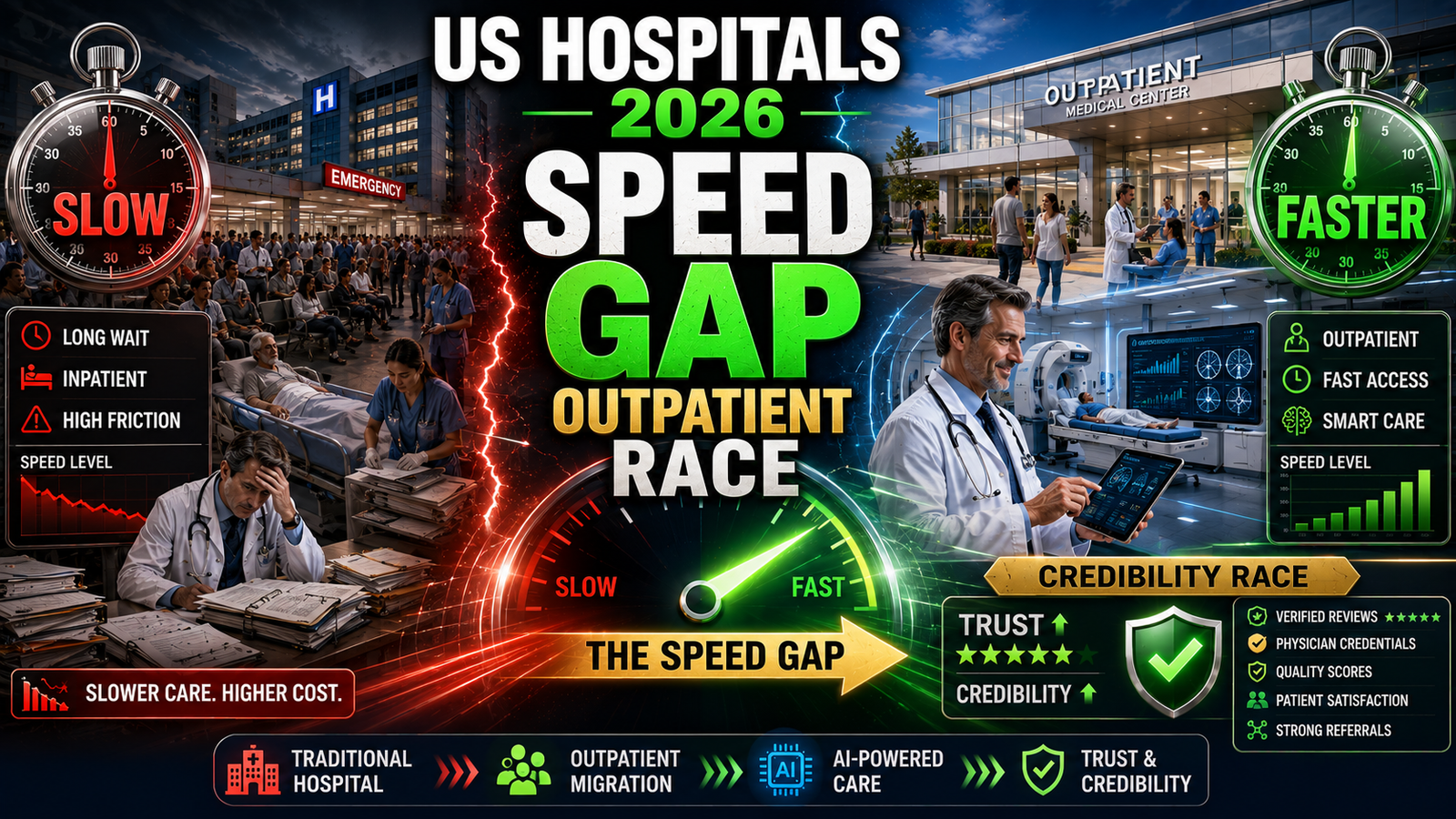
1. The outpatient speed gap matters. For-profit systems are deploying outpatient capital at pace, acquiring multiple ASCs in a single quarter. If your system is still planning while competitors execute, your marketing strategy must address that gap .
2. Build comprehensive content clusters with expert review. Specialized condition and treatment pages with named physician reviewers are required—not one-page overviews .
3. Optimize for GEO, not just SEO. AI search visits grew 42.8% year-over-year. Your content must be structured, sourced, and verifiable for AI extraction .
4. Technical GEO is non-negotiable. Accessibility, healthcare schema, internal linking, and AI crawler access are critical for AI visibility .
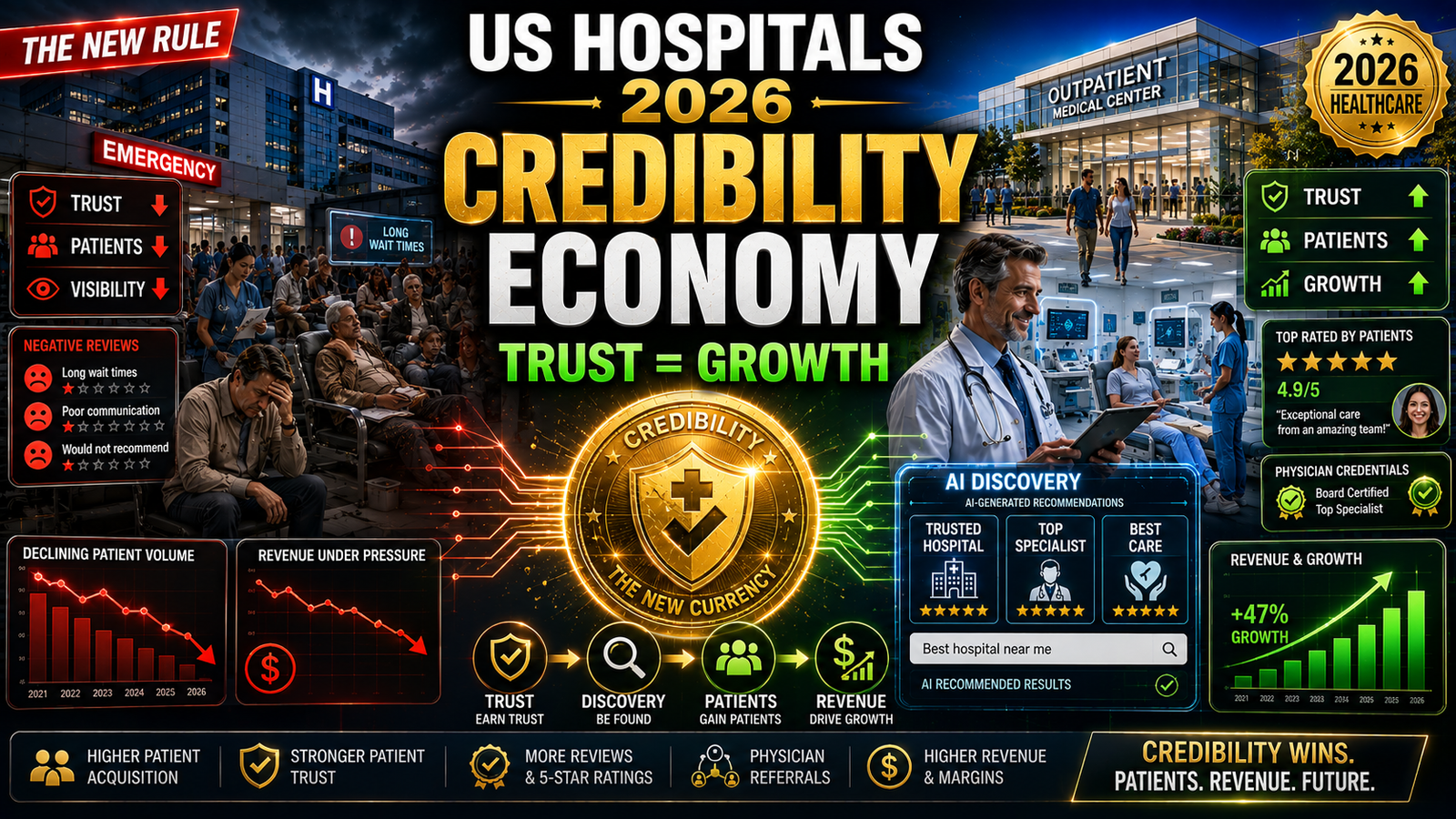
5. Credibility is the new currency. Generalist health sites are being penalized; systems investing in expert-reviewed, structured content earn AI citations and patient trust .
6. Quantify policy exposure. Rating agencies and boards are asking: What’s your Medicaid hit? What’s your mitigation plan?
Conclusion: Visibility Is Survival
The US hospital industry in 2026 is navigating structural pressures that are reshaping competition: a K-shaped recovery widening the gap between winners and losers, $1 trillion in Medicaid cuts putting 446 hospitals at risk, a massive outpatient consolidation wave, and a patient discovery layer increasingly dominated by AI answer engines.
For hospital marketing and SEO professionals, the mandate is clear: every patient who finds you online is a patient your competitors cannot see. The hospitals that invest in structured, expert-reviewed content, technical excellence, and AI-optimized visibility will capture patients in a system where demand outpaces supply. In an era where 302 clinics and hospitals have already closed and thousands of healthcare workers have lost their jobs, credibility is not just a marketing tactic—it is a survival strategy.