sharmaanubhav6660@gmail.com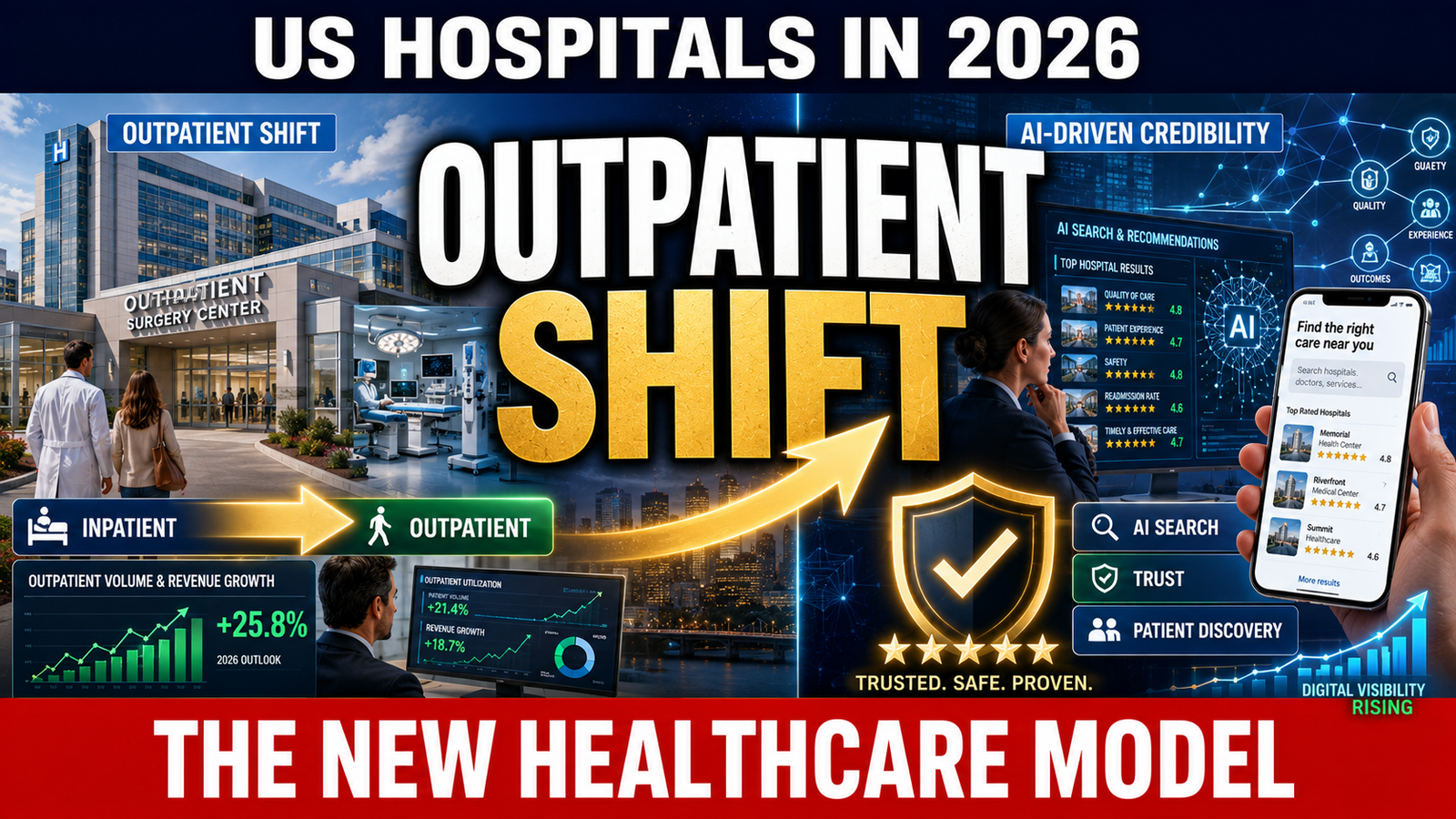
The Outpatient Era: A Fundamental Reset
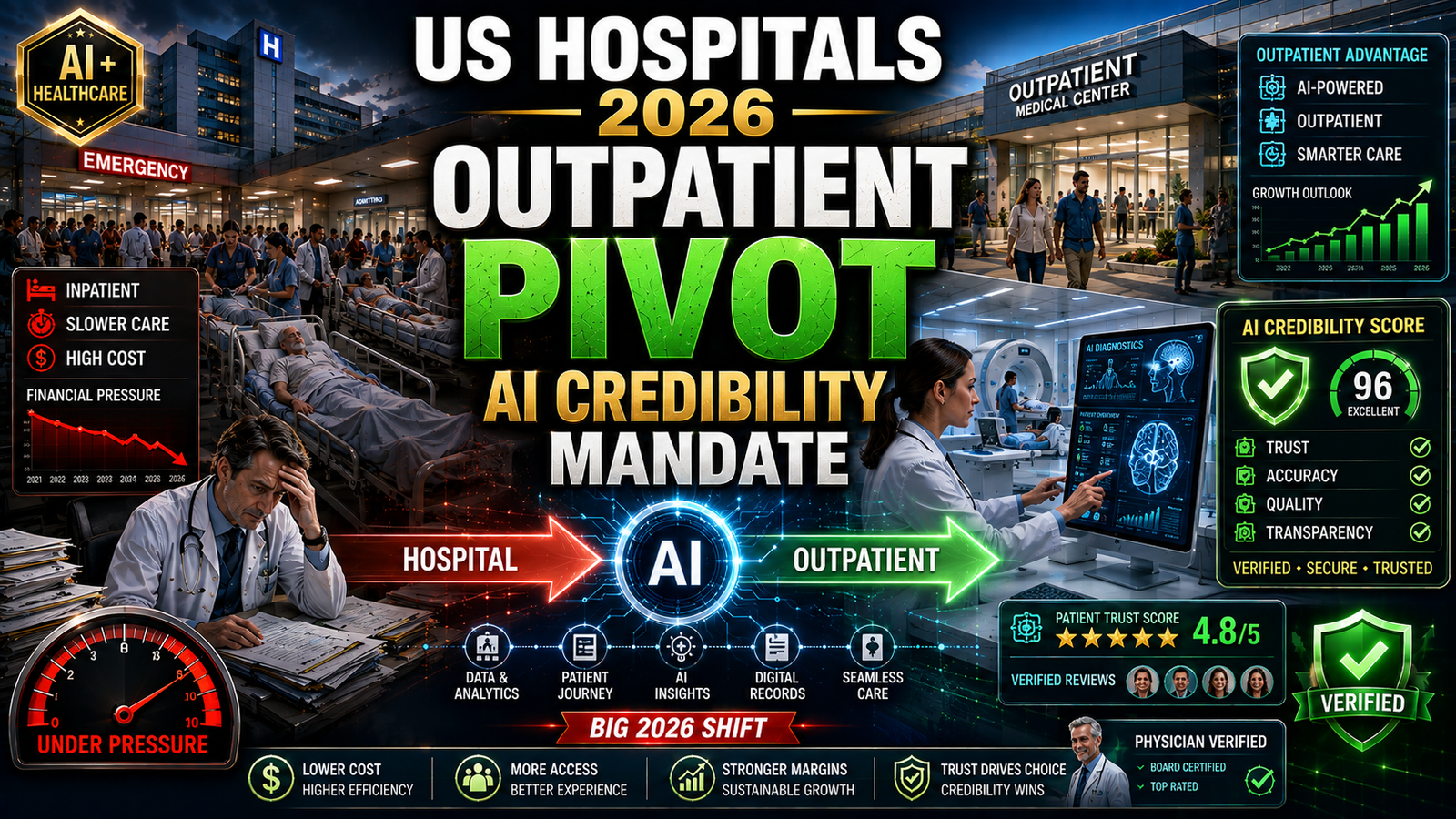
The US hospital industry is navigating a structural transformation that is reshaping how care is delivered, where capital is deployed, and how patients discover providers. The traditional hospital-centric model is giving way to an outpatient-first approach, driven by patient preferences, payer dynamics, and mounting financial pressures.
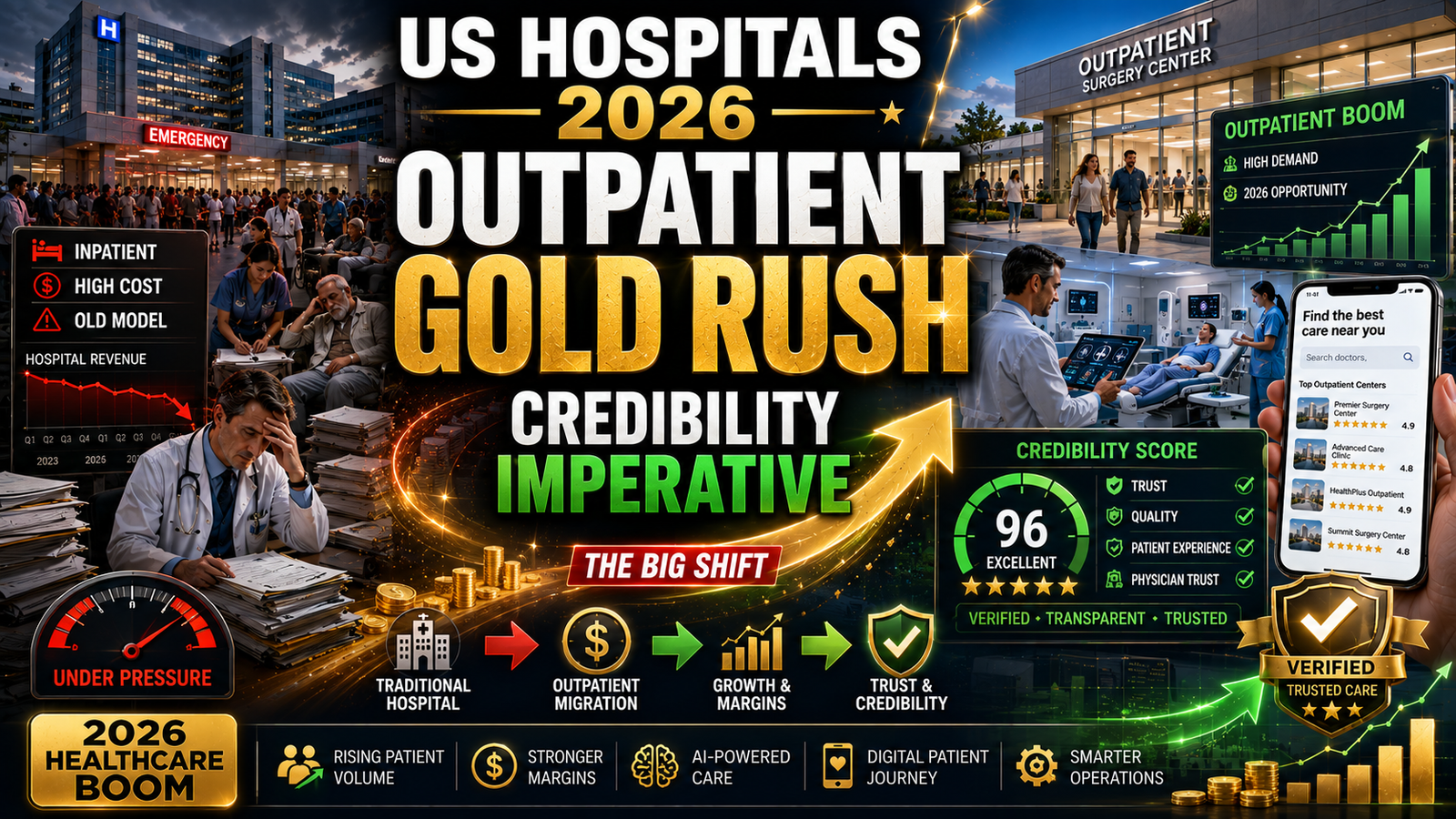
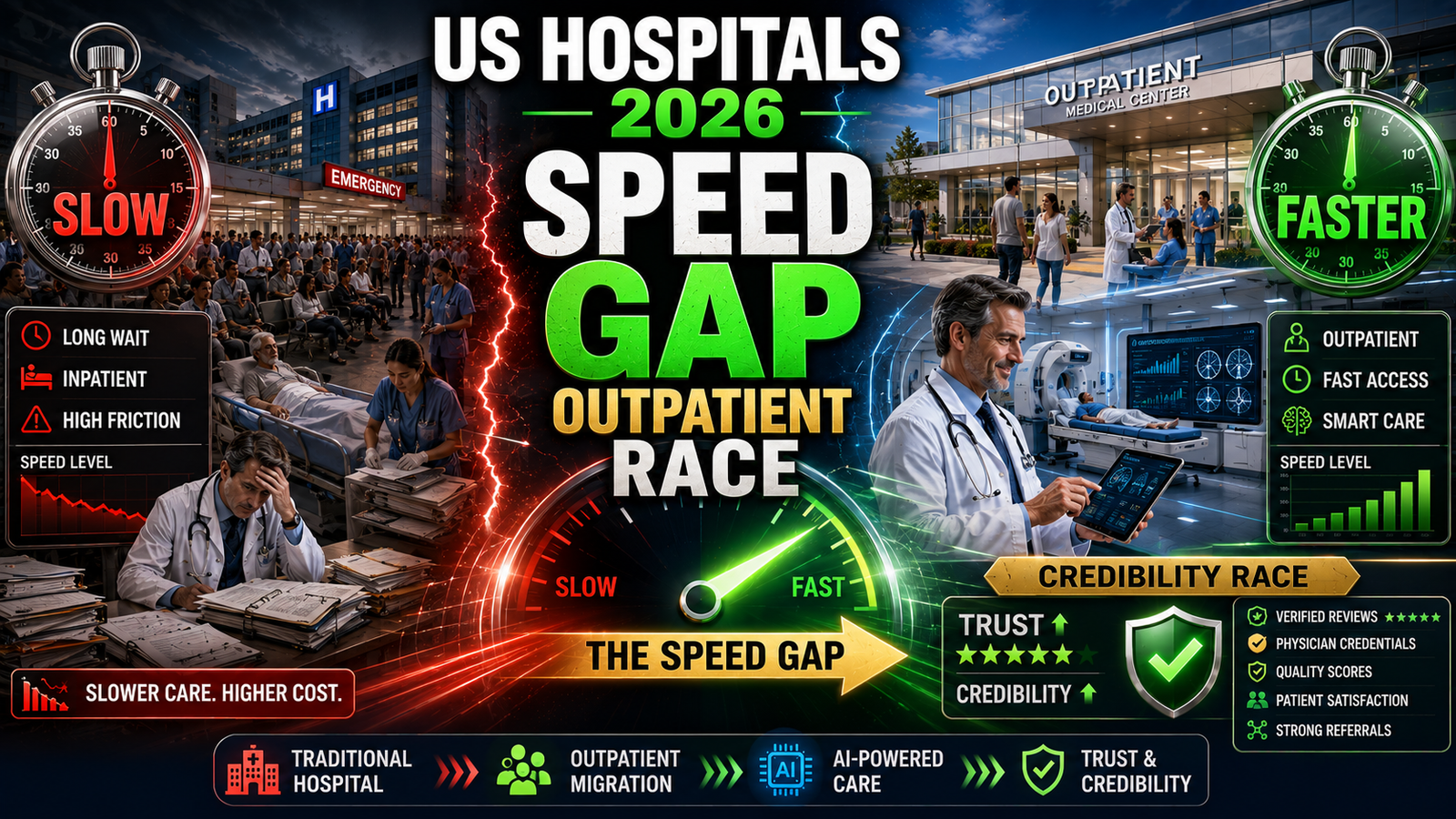
Through May 2026, outpatient revenue per calendar day increased 8% year over year, outpacing the 5% growth in inpatient revenue . At the same time, adjusted patient days rose only 1%, while inpatient discharges remained relatively flat—clear evidence of the industry’s steady migration away from traditional inpatient care .
The financial backdrop is increasingly challenging. Operating revenue per calendar day increased 6% through May, but total expense per calendar day climbed 7%. Labor expense rose 4%, while nonlabor expense increased 9%, reflecting persistent inflationary pressures across hospital operations .
Kaufman Hall analysts wrote: “Traditional hospital care delivery is fundamentally shifting. As outpatient growth continues year-over-year, health systems may consider proactively adapting portfolios and operations to support the future of U.S. healthcare delivery” .
Erik Swanson, managing director at Kaufman Hall, warned: “Demand in outpatient services is on the rise, and hospitals without an outpatient footprint will struggle” .
The ASC Land Grab: Health Systems Bet Big on Outpatient
Health systems, private equity firms, and payers are racing to acquire outpatient assets, particularly ambulatory surgery centers (ASCs). Physician medical groups accounted for a record 46% of all healthcare transactions in the first quarter of 2026—nearly three times as many deals as any other healthcare subsector .
The Ascension-AmSurg Deal
The scale of consolidation is dramatic. Ascension completed its $3.9 billion acquisition of AmSurg, expanding its ASC network to roughly 300 facilities nationwide . AmSurg controls roughly 3.9% of the ASC market with 250-plus centers across 34 states, partnering with about 2,000 physicians.
Ascension itself went from running 139 hospitals in 2022 to operating 90 hospitals and more than 300 ASCs by June 2026 . Amber Sims, Ascension’s executive vice president and chief strategy and growth officer, explained the rationale: “We had to get ahead in the ambulatory business, because that’s where care is going. It’s where patients want to receive care, where payers want to seek care, and where providers want to provide care” .
For-Profit Speed Gap
The for-profit hospital operators are deploying outpatient capital at pace:
Tenet Healthcare offers the clearest example of a health system fully committing to an ASC-first identity. In 2024, the parent company of ASC giant United Surgical Partners International sold 14 hospitals for more than $4.8 billion, channeling the proceeds into ambulatory growth . USPI posted net operating revenues of $1.39 billion in Q2 2026, up 9.3% year over year, with adjusted EBITDA of $542 million, though margin slipped slightly to 39% from 39.2% . Same-facility surgical cases fell 1.2%, but revenue per case rose 6.3%, which Tenet attributed to higher acuity and a more favorable service mix .
Community Health Systems has been executing a parallel playbook. In 2025, the company announced plans to divest seven hospitals while doubling down on ASC investment. In 2026, CHS opened new surgery centers in Birmingham and Foley, Alabama, and acquired a majority stake in an Anchorage, Alaska, ASC, bringing its total to 36 affiliated centers . CEO Kevin Hammons noted procedural softness is concentrated in elective specialties, citing “orthopedics being the largest decline” and cardiac surgery “following the same path” . Net revenue per adjusted admission slipped 0.5% for the quarter .
HCA Healthcare saw outpatient surgery volumes decline 3.4% on a same-facility basis, alongside a 2.3% drop in inpatient surgeries, continuing a softening trend in elective procedures . The bright spot was the emergency department, where ER visits rose 3.6% for the quarter. HCA’s ambulatory footprint remains the largest by location count at roughly 2,600 sites spanning ASCs, freestanding emergency rooms, urgent care centers, and physician clinics .
Universal Health Services is the outlier of the group—not a major ASC operator, with outpatient growth centered on behavioral health. The company’s pending acquisition of Talkspace is intended to build what CEO Mark Miller called “the nation’s first end-to-end continuum of behavioral healthcare services,” spanning acute inpatient, residential care, in-person outpatient treatment, and national virtual services .
A recent VMG Health survey found outpatient surgery ranked as health systems’ top service line for joint venture investment, with more than 60% of executives identifying ASCs as a primary growth priority. Roughly 75% of hospitals structure ASC investments as physician joint ventures .
The Policy Storm: OBBBA and Medicaid Cuts
The dominant threat to hospital credit profiles is the One Big Beautiful Bill Act (H.R. 1) , enacted in 2025. The law cuts nearly $1 trillion from Medicaid over 10 years, imposes 80-hour monthly work requirements for Medicaid expansion adults ages 19 to 64 effective January 2027, and limits hospital funding sources like state-directed payments .
CMS Proposed Rule: 3.4 Times More Than Congress Intended
The rule implementing OBBBA provisions would increase federal funding cuts to $510 billion over 10 years—3.4 times more than what Congress intended . The law included SDP changes that would cut nearly $150 billion over 10 years; CMS’s rule expands those cuts significantly.
State-Level Impacts
State responses highlight the geographic concentration of exposure. Although Kentucky is only the twenty-sixth most populous state, its $4.3 billion SDP is tied with two other states as the sixth largest . Sweetwater Hospital in Tennessee warned the rule’s SDP phase-down approach would cut more than $320 million annually from hospitals in the state .
Louisiana is the twenty-fifth most populous state and tied for sixth largest SDP ($4.3 billion), covering 30% of its population through Medicaid . Paul Salles, president and CEO of the Louisiana Hospital Association, wrote that the rule’s cuts would “inevitably force hospitals to reduce services, defer capital investments, delay workforce initiatives or reconsider access points that are already financially vulnerable” .
446 Hospitals at Risk
Protect Our Care, a Democratic-aligned advocacy group, reports tracking over 400 hospitals at risk of closure or cuts due to OBBBA. More than 80 hospital wards—including maternity and pediatric units—have already shuttered . The group found that more than 1,000 hospitals, clinics, hospital wards, nursing homes, and providers are closing, cutting services, or at risk .
Rating Agencies Seek Quantified Exposure and Mitigation Plans
In conversations with health systems, ratings agencies hope to hear insight about prospective repercussions. Kevin Holloran, senior director at Fitch Ratings, emphasized: “What’s your hit, what’s your exposure? It’s $10 million, it’s $100 million, it’s a billion dollars. Give me a number, and then give me those mitigants that you’ve got to work for it” .
The cuts are heavily backloaded—only 6% of total cuts take effect from 2025 to 2027. From 2028 to 2034, the remaining 76% of funding reductions take effect, increasing pressure on states to fund programs from general revenues, reduce optional benefits, or narrow provider networks . This timetable gives hospitals time to adapt, but the delayed impact means the full weight of the cuts will arrive after the 2026 midterm elections.
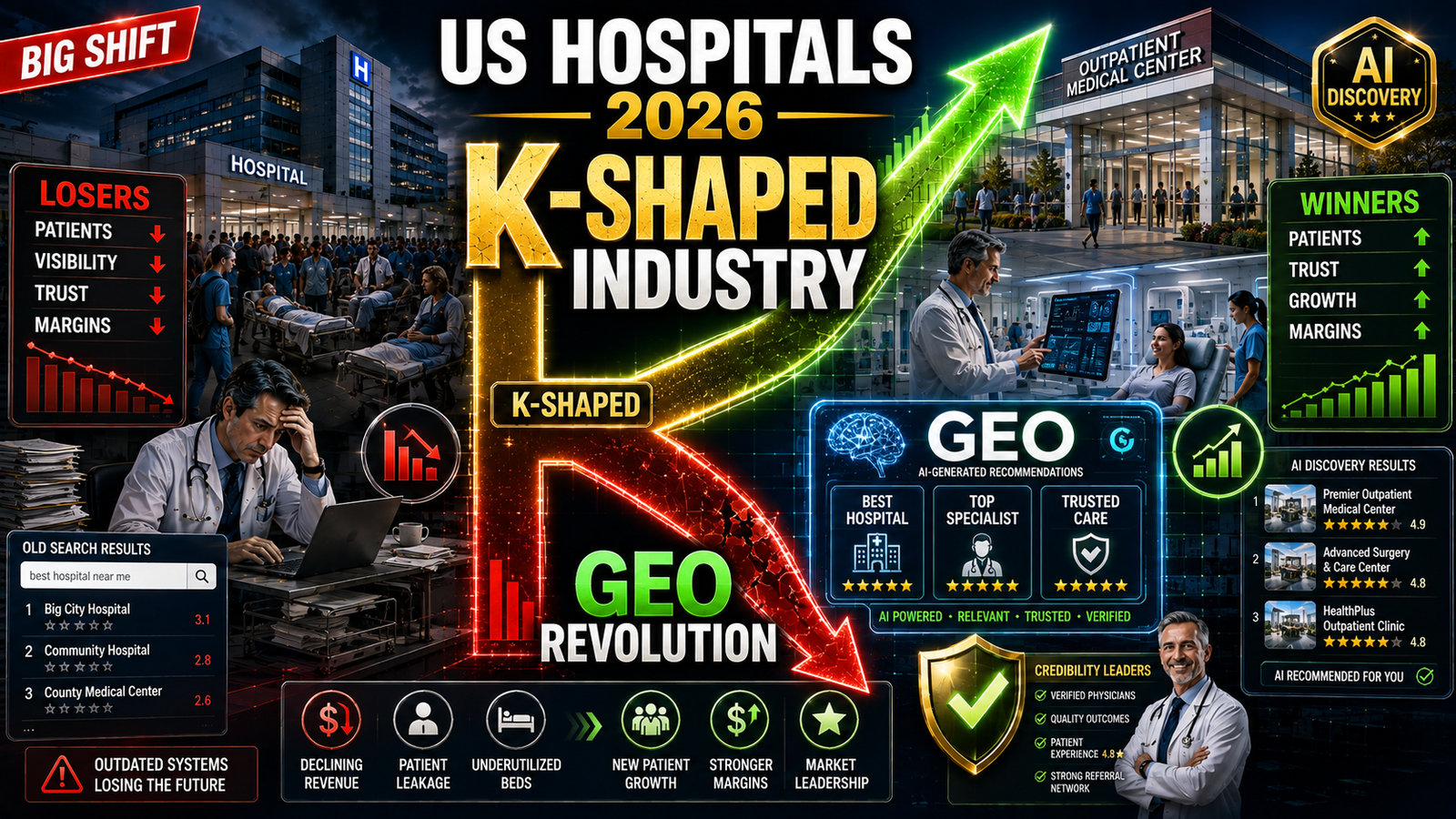
The Credibility Era: GEO for Healthcare
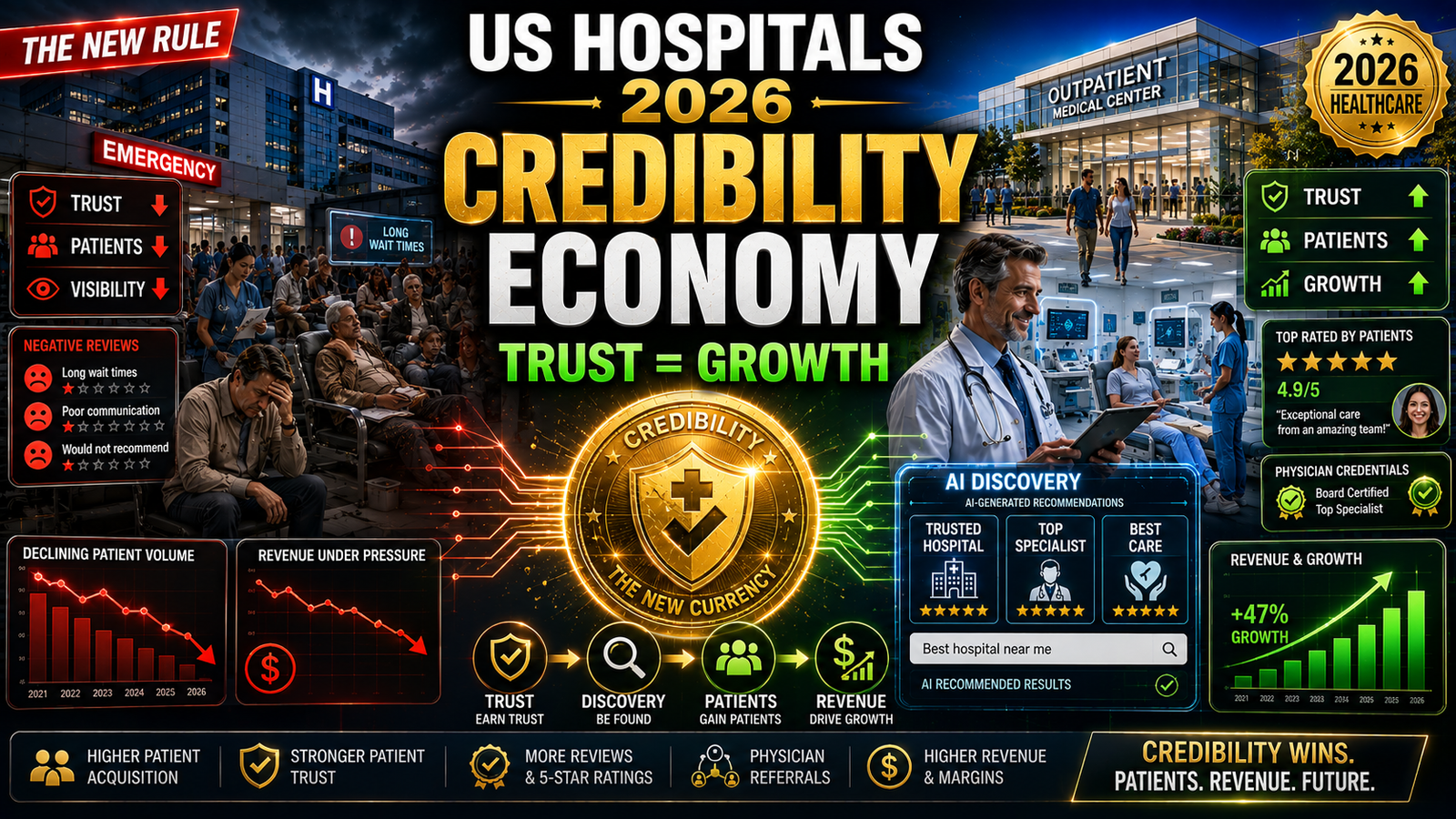
As patients increasingly use AI search and chatbots to find health information, health system marketers are pivoting from SEO to GEO—generative engine optimization. Sixteen percent of Americans now turn to chatbots such as ChatGPT and Gemini for medical advice, according to a recent Gallup poll .
Why Healthcare Needs GEO
Patients increasingly start health research inside AI assistants rather than a search results page. When an AI engine answers a symptom or treatment query, it pulls from a small set of trusted sources. A health system absent from that set loses visibility at the exact moment a patient is choosing where to seek care .
The shift is measurable. AI search visits grew 42.8% year over year, rising from 15.6 billion in Q1 2025 to 27.4 billion in Q1 2026 . Health systems that rely only on classic SEO are now optimizing for a channel that grows far slower than the one patients are adopting.
How AI Engines Pick Sources
AI engines reward content that is structured, sourced, and verifiable. Evidence matters more than tone :
- Adding statistics increases AI visibility by 22%
- Adding quotations raises it by 37%
- Cited text is nearly twice as likely to contain definitive language: 36.2% versus 20.3%
- 44.2% of ChatGPT citations come from the first 30% of page text
- 65% of AI bot hits target content published within the past year
Build Expert-Reviewed Content
Expert review is the foundation of healthcare GEO. Every clinical page should name the reviewing physician, list credentials, show a review date, and link to current medical literature . These signals tell AI engines the content is accountable and protect patients from inheriting errors.
Structure Pages for Extraction
AI engines extract structured content far more reliably than prose. The format gap is large: tables get extracted by LLMs at 81% versus 23% for prose . Use clear question-style headings, short answer paragraphs, comparison tables, and FAQ blocks. Add medical schema markup—MedicalOrganization, Physician, MedicalCondition, and FAQPage—so AI engines can parse authorship, conditions, and procedures without guessing .
How Health Systems Are Responding
Marketing leaders across the country are reorienting strategies to the AI-driven discovery era:
SSM Health is changing the way it writes and distributes content to optimize “patient and consumer understanding and AI interpretation.” Ashley Pollard, vice president of marketing, captured the shift: “The traditional model where consumers ask Google a question and navigate multiple websites for answers is becoming obsolete. As AI evaluates every digital touchpoint, a holistic focus on the quality, credibility and structure of our content across the entire digital ecosystem is no longer optional—it is essential” .
Banner Health is “auditing and modernizing legacy content, using performance data and external search optimization tools to identify gaps and emerging patient intent” . “Our focus has shifted from traffic volume alone to high-intent visibility and conversion,” said Don Stanziano, senior vice president and chief marketing officer .
Intermountain Health is “trading pageviews for high-intent engagement,” no longer relying on web traffic as a performance benchmark . Chief Marketing Officer Megan Mahncke explained: “Instead, our goal is to be a reliable source that AI tools reference in their search results. Success is measured by consumer conversion after that first discovery” .
NYU Langone Health is “laser-focused on showing up as a trusted and authoritative source” within AI platforms, ensuring “AI tools recognize NYU Langone Health as a leading clinical authority and source of truth” . Elizabeth Golden, executive vice president for communications and marketing, said: “Our goal is not just maintaining online traffic, but ensuring we remain a leading destination that patients trust and choose” .
CommonSpirit Health is leaning into nonpaid, credible content. Chief Marketing Officer Adam Rice said: “Building on a strong SEO foundation, we are restructuring content for AI readability and implementing technical standards that improve how large language models interpret and accurately cite our trusted health information” .
Universal Health Services is “putting emphasis on building continued trust and credibility through service-line-specific video content, including doctor/expert-led explainer videos and patient and community endorsements, and actively managing Google reviews—key strategies in a time of rising health misinformation” . Roselle Charlier, VP and chief marketing officer, also noted the organization is “focused on SEO and AEO (answer engine optimization)—enabling prospective patients and their loved ones to easily access timely, relevant information” .
Real-World GEO Results
A medical GEO case study showed AI visibility improved from 18% to 44% (+26%), SOV increased 133%, brand citations rose 157%, and semantic hallucination rates dropped from 22% to 9% over a 5-month optimization period . These gains are within a reasonable engineering optimization range—30% to 80%—suggesting systematic improvements rather than statistical noise .
Technical GEO: robots.txt and IndexNow
Your technical SEO configuration determines whether AI crawlers can even access your medical content. No GEO strategy works if bots are blocked at the door. Add these directives to your robots.txt :
- OAI-SearchBot (ChatGPT)
- PerplexityBot
- Google-Extended
- anthropic-ai (Claude)
Because ChatGPT’s live web browsing is powered by Bing’s index, implement the IndexNow protocol to ping Bing the moment you publish or update a page. This makes your content immediately retrievable for ChatGPT search queries .
Weekly GEO Audit Framework
Run this audit weekly :
- Prompt test: Type 5-10 patient queries into ChatGPT, Gemini, Perplexity, and Copilot. Record whether your system is cited and what source the citation comes from.
- Directory consistency: Verify NAP, provider names, specialties, and insurance acceptance match across Healthgrades, Zocdoc, Yelp, Google Business Profile, and your website.
- Content freshness: Any medical page not updated in 90 days loses recency weight. Update dateModified schema and refresh clinical references quarterly.
- Schema validity: Run key pages through Google’s Rich Results Test to confirm error-free medical schema.
Common GEO Mistakes to Avoid
- Blocking AI bots in robots.txt: AI crawlers cannot cite pages they are blocked from
- No credentialed author on medical pages: AI models filter unattributed YMYL content from citation pools
- Generic “About Us” schema only: Implement MedicalOrganization + Physician schema with actual provider details
- Vague clinical language: “Comprehensive care” gives AI nothing extractable to cite
- No direct answer blocks: Answer every H2 question in the first 40-60 words
- Passive Bing crawling: ChatGPT cannot cite pages not yet in Bing’s index—implement IndexNow
Conclusion
The US hospital industry in 2026 is navigating structural pressures that are reshaping competition: a $3.9 billion ASC consolidation wave, $510 billion in Medicaid cuts beyond statutory intent, and a patient discovery layer increasingly dominated by AI answer engines.
The for-profit speed gap is clear. Tenet, CHS, and HCA are deploying outpatient capital at scale while many NFP systems remain in the planning phase. As Ashley Pollard of SSM Health observed: “As AI evaluates every digital touchpoint, a holistic focus on the quality, credibility and structure of our content across the entire digital ecosystem is no longer optional—it is essential” .
For hospital marketing and SEO professionals, the mandate is clear: every patient who finds you online is a patient your competitors cannot see. The hospitals that invest in structured, expert-reviewed content, technical excellence, and AI-optimized visibility will capture patients in a system where demand outpaces supply. In an era of AI-mediated discovery, credibility is not just a marketing tactic—it is a survival strategy.