sharmaanubhav6660@gmail.com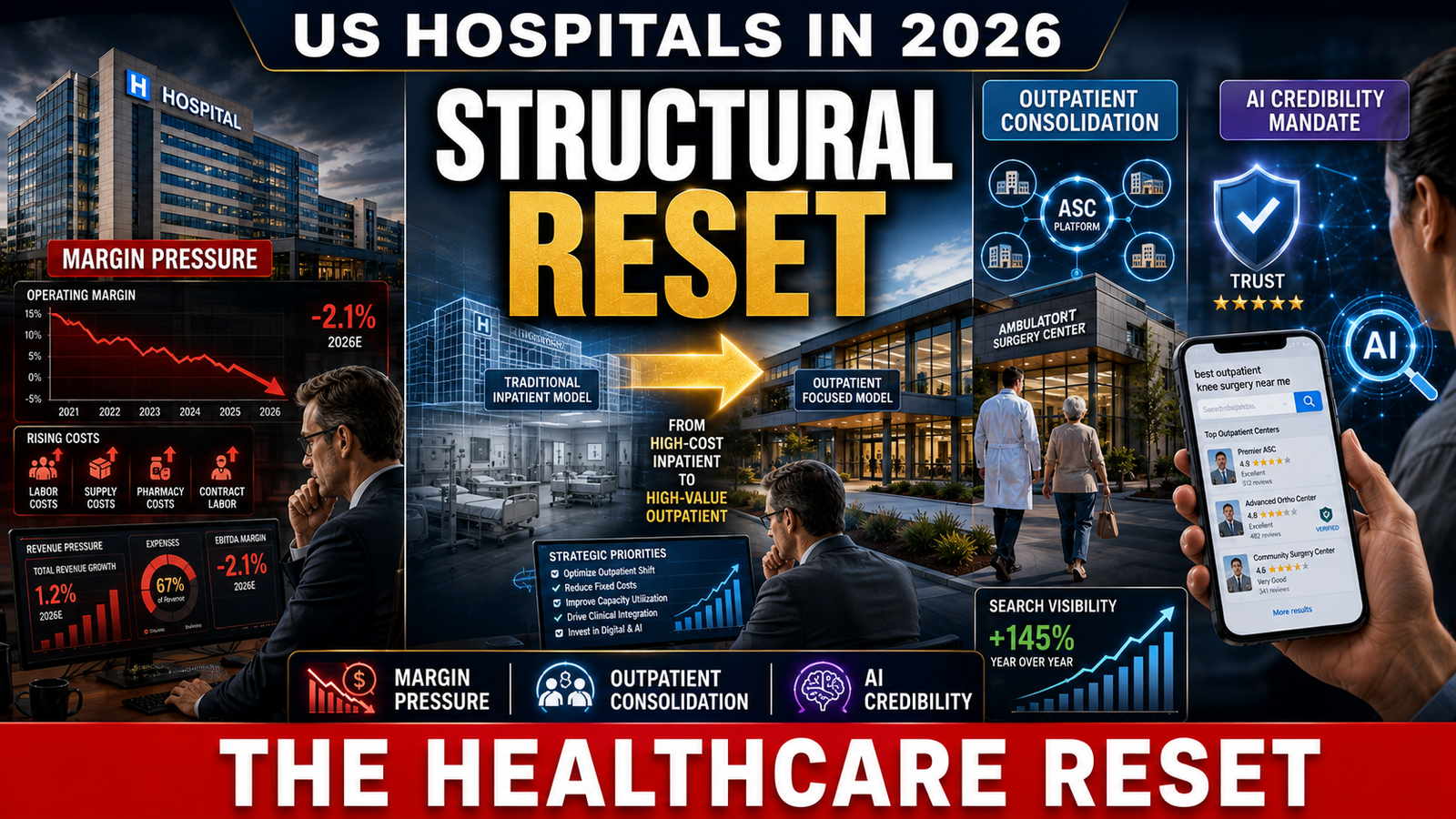
The K-Shaped Recovery and a Soft Start to the Year
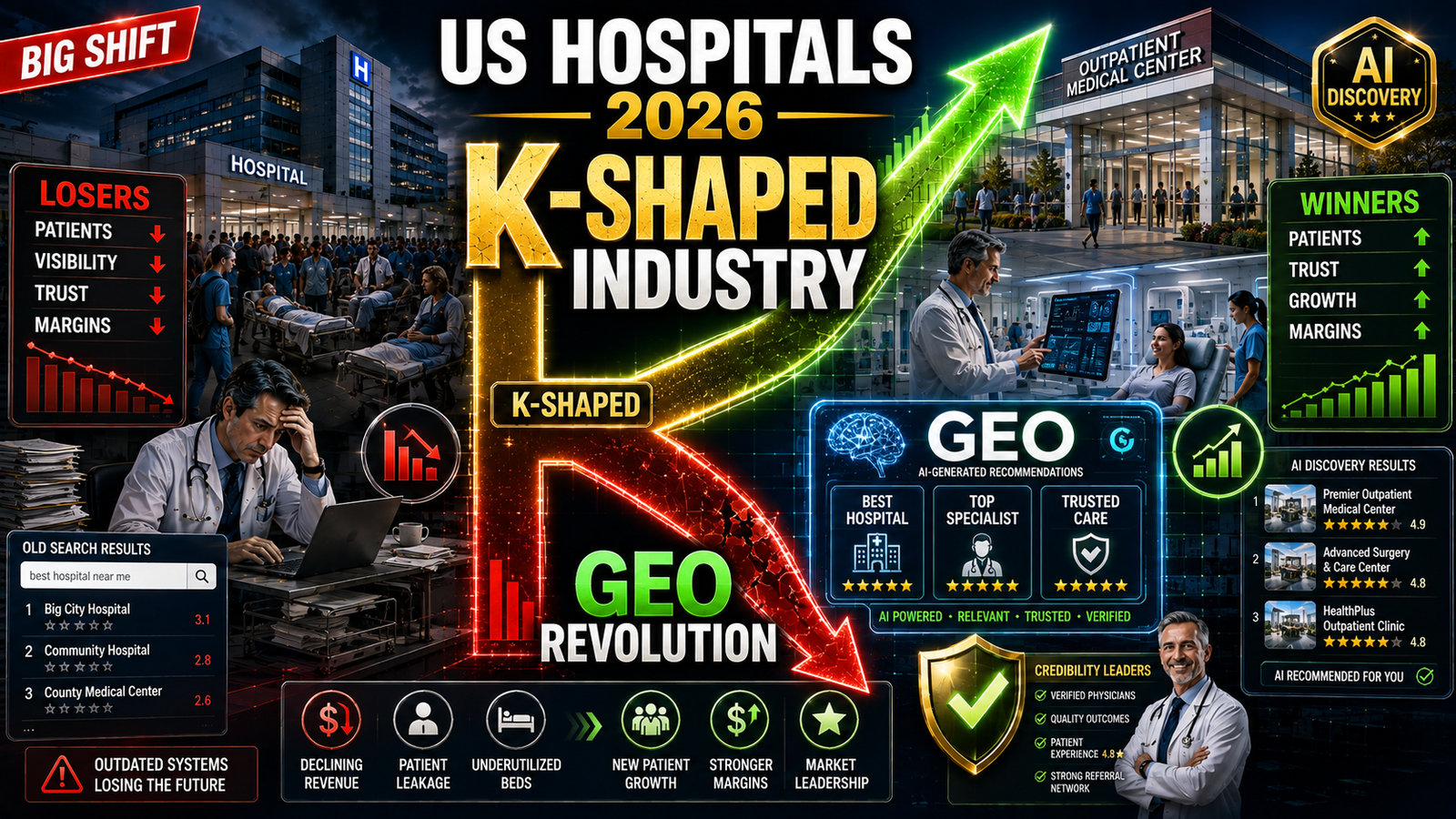
The U.S. hospital sector began 2026 with a divergence that analysts describe as a “K-shaped” recovery, where strong systems pull ahead while weaker institutions face existential strain. Hospitals nationwide posted broad revenue growth to open 2026, with U.S. hospital net operating revenue rising 5% per calendar day in Q1 compared to the previous year, and gross operating revenue growing 7% . However, the year-to-date operating margin index stood at 1.9% through February, considerably below the 3.7% margin posted at the end of 2025 .
The picture beneath the surface is more complicated. Bad debt and charity care climbed 8% year-over-year, while patient volumes dropped across inpatient, outpatient, and emergency settings. Discharges fell 2%, emergency department visits dropped 5%, and total costs per calendar day increased 5%—with supply costs up 5%, drug expenses rising 7%, and labor costs climbing another 5% .
The Outpatient Imperative
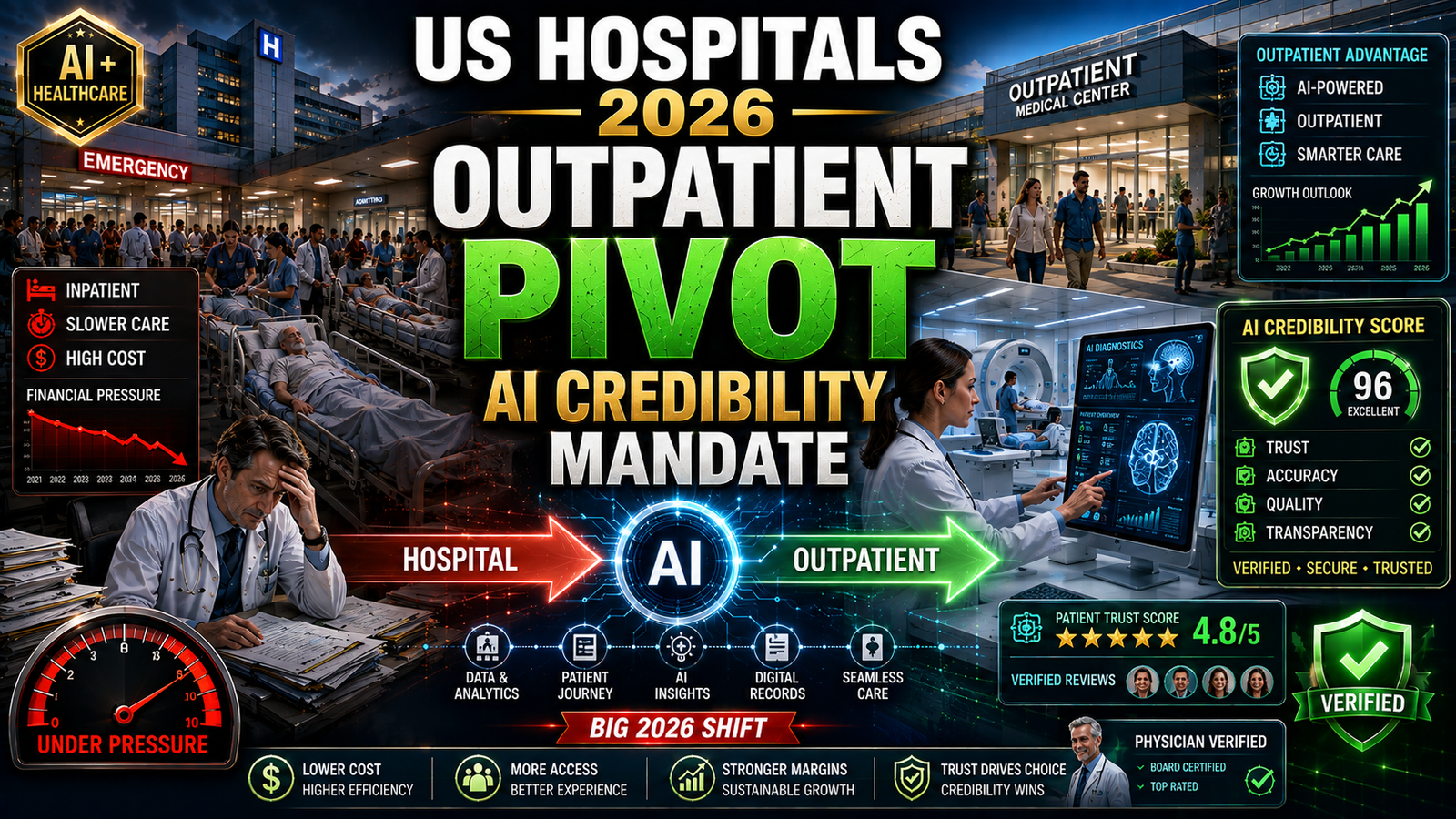
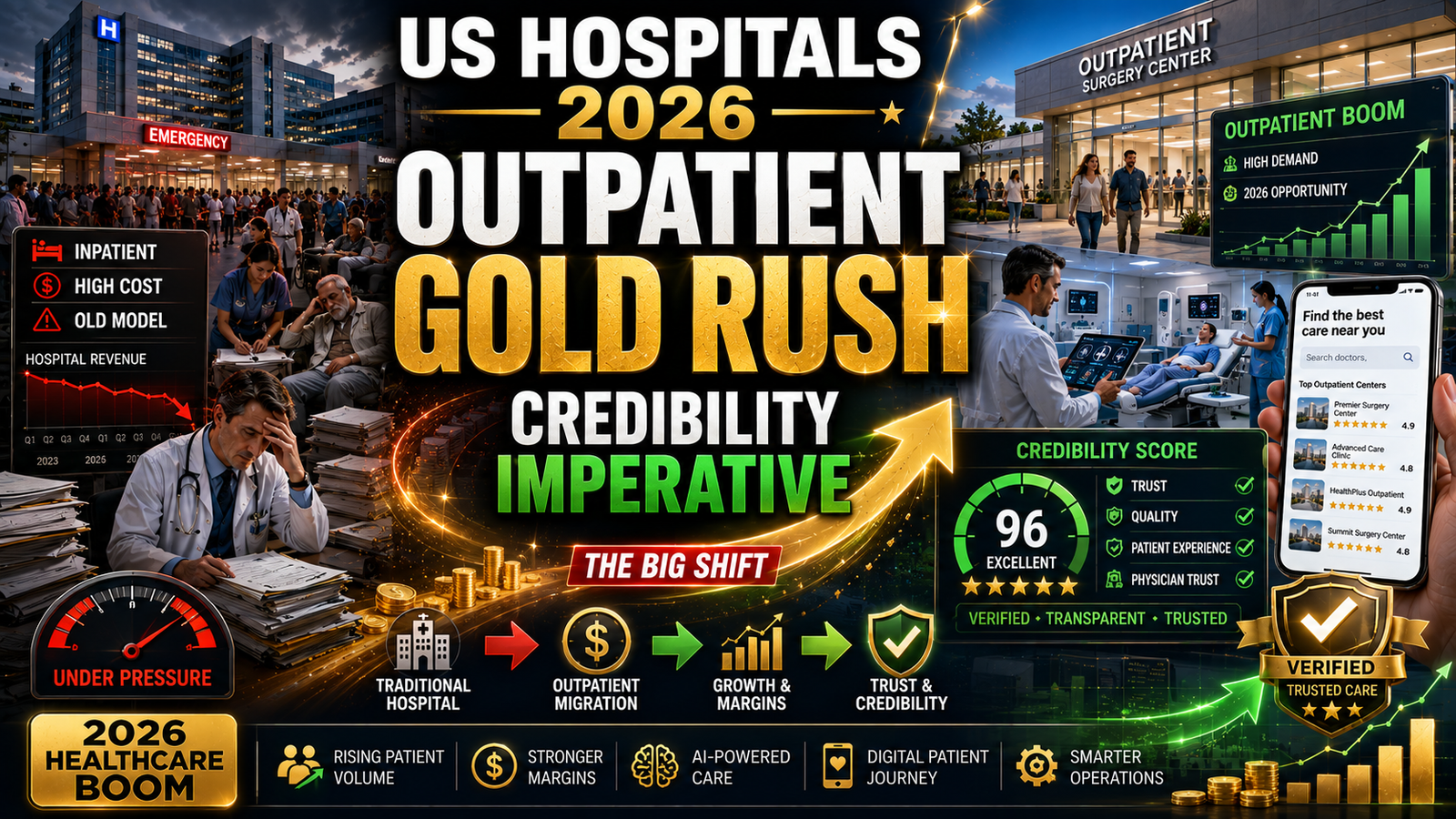
Outpatient care was the clearest driver of revenue growth, outpacing inpatient revenue in every region and nearly every bed-size category nationwide . Outpatient revenue grew 8% nationally, while inpatient revenue increased just 4% . Through May, outpatient revenue per calendar day increased 8% year over year, while inpatient discharges remained relatively flat . Outpatient revenue surged 7% month-over-month and year-over-year in February .
Regional performance varied dramatically:
- Western hospitals led all regions, with outpatient revenue surging 13%
- Southern hospitals posted 9% outpatient revenue growth and the highest inpatient growth at 5%
- Midwest hospitals posted the most modest gains, with outpatient revenue up just 5%
Hospitals in the 200–299 bed range led all size segments: net operating revenue up 8%, inpatient revenue up 7%, and outpatient revenue up 10%. The smallest hospitals—0 to 25 beds—recorded the steepest inpatient revenue decline at -2%, even as outpatient revenue grew 4% .
The Outpatient Shift Tradeoff
As more care moves to outpatient settings, hospitals face revenue dilution and a higher concentration of complex, high-acuity patients on the inpatient side . Volume trends reinforce this dynamic: discharges per calendar day fell 2%, adjusted patient days declined 1%, average length of stay dropped 4%, and emergency department visits decreased 5% .
Erik Swanson, managing director at Kaufman Hall, summarized the predicament: “Hospitals are off to a relatively soft start in 2026. Outpatient care strategies offer a potential path forward, though hospitals must manage both revenue dilution and a greater concentration of high-acuity patients” . He added: “Demand in outpatient services is on the rise, and hospitals without an outpatient footprint will struggle” .
The ASC Land Grab: Consolidation at Unprecedented Scale
The Ascension-AmSurg Deal
Health systems, private equity firms, and payers are racing to acquire outpatient assets, particularly ASCs. The scale of consolidation is dramatic. Ascension completed its $3.9 billion acquisition of AmSurg on June 4, expanding its ASC footprint to roughly 300 facilities nationwide . AmSurg controls roughly 3.9% of the ASC market with 250-plus centers across 34 states and partners with about 2,000 physicians . Ascension itself went from running 139 hospitals in 2022 to operating 90 hospitals and more than 300 ASCs by June 2026 .
Amber Sims, Ascension’s executive vice president and chief strategy and growth officer, explained: “We had to get ahead in the ambulatory business, because that’s where care is going. It’s where patients want to receive care, where payers want to seek care, and where providers want to provide care” .
FTC Scrutiny
The FTC required seven divestitures across five states before approving the transaction—the first time regulators applied that level of scrutiny to an ASC-specific deal . The consent order requires Ascension to provide prior notice before acquiring any ASCs in the affected metropolitan areas for 10 years . The FTC’s framework was explicitly local. “The FTC is defining ASCs as highly localized monopoly markets,” Sean Gipson, CEO of Houston-based Remedy Surgery Center, told Becker’s. “Competition is not national or even statewide—it is metro-area specific and service-line specific” .
For-Profit Speed Gap
The four largest publicly traded hospital companies are deploying outpatient capital at pace:
- Tenet Healthcare deployed $125 million in Q1 2026 to acquire seven ASCs, representing half of its annual M&A target for USPI, which now operates nearly 570 assets . USPI posted net operating revenues of $1.39 billion in Q2, up 9.3% year over year, and adjusted EBITDA of $542 million, up 8.8% .
- Community Health Systems is purchasing a majority stake in an ASC operator in Anchorage, opening de novo ASCs in Alabama, and acquiring the Surgical Institute of Alabama—an 8,000+ annual case facility .
- HCA continued outpatient acquisitions in urgent care, ASC, and freestanding ED platforms. Q2 saw HCA’s outpatient surgery volumes decline 3.4% on a same-facility basis, though pricing offset volume softness with revenue per equivalent admission growing 6.4% .
- UHS is the outlier of the group—not a major ASC operator, with outpatient growth centered on behavioral health .
The Policy Storm: $1 Trillion in Medicaid Cuts
The One Big Beautiful Bill Act
The dominant threat to hospital credit profiles is the One Big Beautiful Bill Act (H.R. 1) , enacted in 2025. The law imposes 80-hour monthly work requirements for Medicaid expansion adults ages 19 to 64, effective January 2027, and cuts nearly $1 trillion from Medicaid over 10 years .
CMS Proposed Rule: 3.4 Times More Than Congress Intended
CMS has proposed rule changes implementing provisions of the OBBBA that go beyond what Congress intended. The law included SDP changes that would cut nearly $150 billion from them over 10 years. However, the rule implementing those provisions would increase federal funding cuts to $510 billion over 10 years—3.4 times more than Congress intended .
America’s Essential Hospitals estimated OBBBA will increase hospital uncompensated care costs by $466 billion over 10 years .
State-Level Impacts
State responses highlight the geographic concentration of exposure. Kentucky, the twenty-sixth most populous state, has $4.3 billion in SDPs, tied with two other states as the sixth largest . Sweetwater Hospital in Tennessee warned the rule’s SDP phase-down approach would cut more than $320 million annually from hospitals in the state . Louisiana is the twenty-fifth most populous state and tied for sixth largest SDP ($4.3 billion), covering 30% of its population through Medicaid . Paul Salles, president and CEO of the Louisiana Hospital Association, wrote that the rule’s cuts would “inevitably force hospitals to reduce services, defer capital investments, delay workforce initiatives or reconsider access points that are already financially vulnerable” .
446 Hospitals at Risk
Protect Our Care, a Democratic-aligned advocacy group, reports tracking over 400 hospitals at risk of closure or cuts due to OBBBA . More than 80 hospital wards—including maternity and pediatric units—have already shuttered. The group found that more than 1,000 hospitals, clinics, hospital wards, nursing homes, and providers are closing, cutting services, or at risk .
Implementation Timeline: The Backloaded Cliff
The cuts are heavily backloaded. Only 6% of total cuts take effect from 2025 to 2027 (ramp-up). From 2028 to 2034, the remaining 76% of funding reductions take effect, increasing pressure on states . This timetable gives hospitals time to adapt, but the delayed impact means the full weight of the cuts will arrive after the 2026 midterm elections.
The Credibility Era: GEO for Healthcare
From SEO to GEO
As patients increasingly use AI search and chatbots for health information, healthcare marketers are pivoting to Generative Engine Optimization (GEO). AI search visits grew 42.8% year over year, rising from 15.6 billion in Q1 2025 to 27.4 billion in Q1 2026 . A health system absent from AI-generated answers loses visibility at the exact moment a patient is choosing where to seek care.
How AI Engines Pick Sources
AI engines reward content that is structured, sourced, and verifiable . Evidence matters more than tone:
- Adding statistics increases AI visibility by 22%
- Adding quotations raises it by 37%
- Cited text is nearly twice as likely to contain definitive language: 36.2% versus 20.3%
- 44.2% of ChatGPT citations come from the first 30% of page text
- 65% of AI bot hits target content published within the past year
Build Expert-Reviewed Content
Expert review is the foundation of healthcare GEO. Every clinical page should name the reviewing physician, list credentials, show a review date, and link to current medical literature . These signals tell AI engines the content is accountable and protect patients from inheriting errors.
Structure Pages for Extraction
AI engines extract structured content far more reliably than prose. The format gap is large: tables get extracted by LLMs at 81% versus 23% for prose . Use clear question-style headings, short answer paragraphs, comparison tables, and FAQ blocks. Add medical schema markup—MedicalOrganization, Physician, MedicalCondition, and FAQPage—so AI engines can parse authorship, conditions, and procedures without guessing.
Real-World GEO Results
A medical GEO case study showed AI visibility improved from 18% to 44% (+26%), SOV increased 133%, brand citations rose 157%, and semantic hallucination rates dropped from 22% to 9% over a 5-month optimization period .
Content Clusters and Authority Pathways
Content clusters—a pillar page supported by related subtopic pages—mirror how Google’s AI systems understand conditions, treatments, and patient journeys . A joint replacement cluster might include the pillar page, then branch into preparation, surgery types, recovery timelines, physical therapy, and long-term outcomes—all interconnected and demonstrating comprehensive expertise. Siteimprove recommends mapping clusters and authority pathways before publishing, identifying which pages to expand to expert depth, which thin content needs consolidating, and which new pages fill critical gaps .
Technical Priorities
Siteimprove identifies three technical priority areas :
- Accessibility: Heading hierarchy, color contrast, alt text, and keyboard navigation. Older adults abandon sites that don’t work with screen readers or keyboard controls. Google penalizes inaccessible pages.
- Technical SEO validation: Broken links, orphaned pages, missing meta descriptions, canonical tags, crawlability, and mobile usability.
- Brand consistency: Consistent tone, legal disclaimers, and brand terminology across departments.
Key Takeaways for Hospital Marketing Leaders
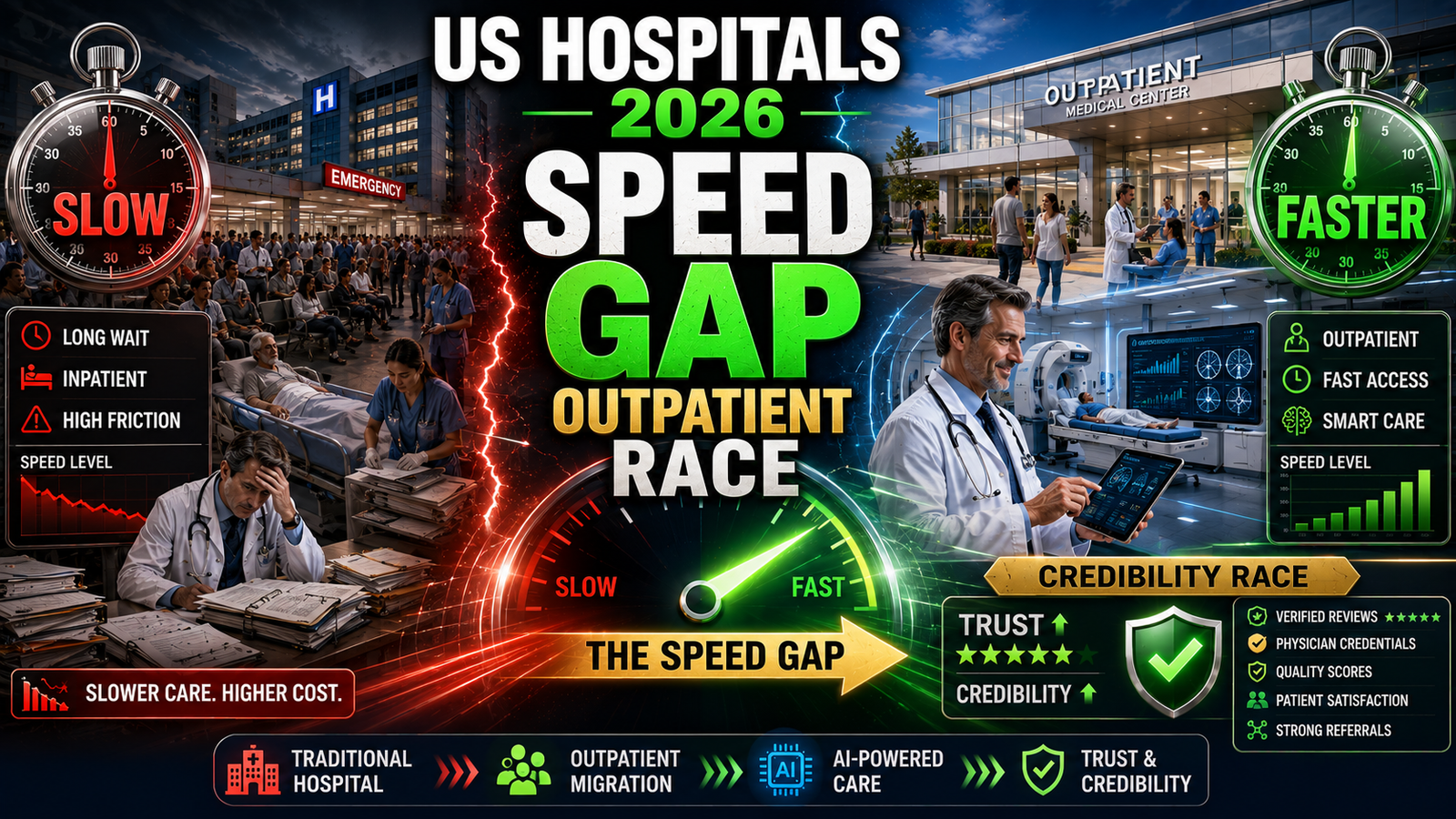
- The outpatient speed gap matters. The ASC land grab is accelerating, with health systems acquiring multiple facilities in a single quarter . If your system is still planning while competitors execute, your marketing strategy must address that gap.
- Build comprehensive content clusters with expert review. Specialized condition and treatment pages with named physician reviewers are required—not one-page overviews .
- Optimize for GEO, not just SEO. AI search visits grew 42.8% year-over-year. Your content must be structured, sourced, and verifiable for AI extraction .
- Technical SEO is non-negotiable. Accessibility, healthcare schema, internal linking, and AI crawler access are critical for AI visibility .
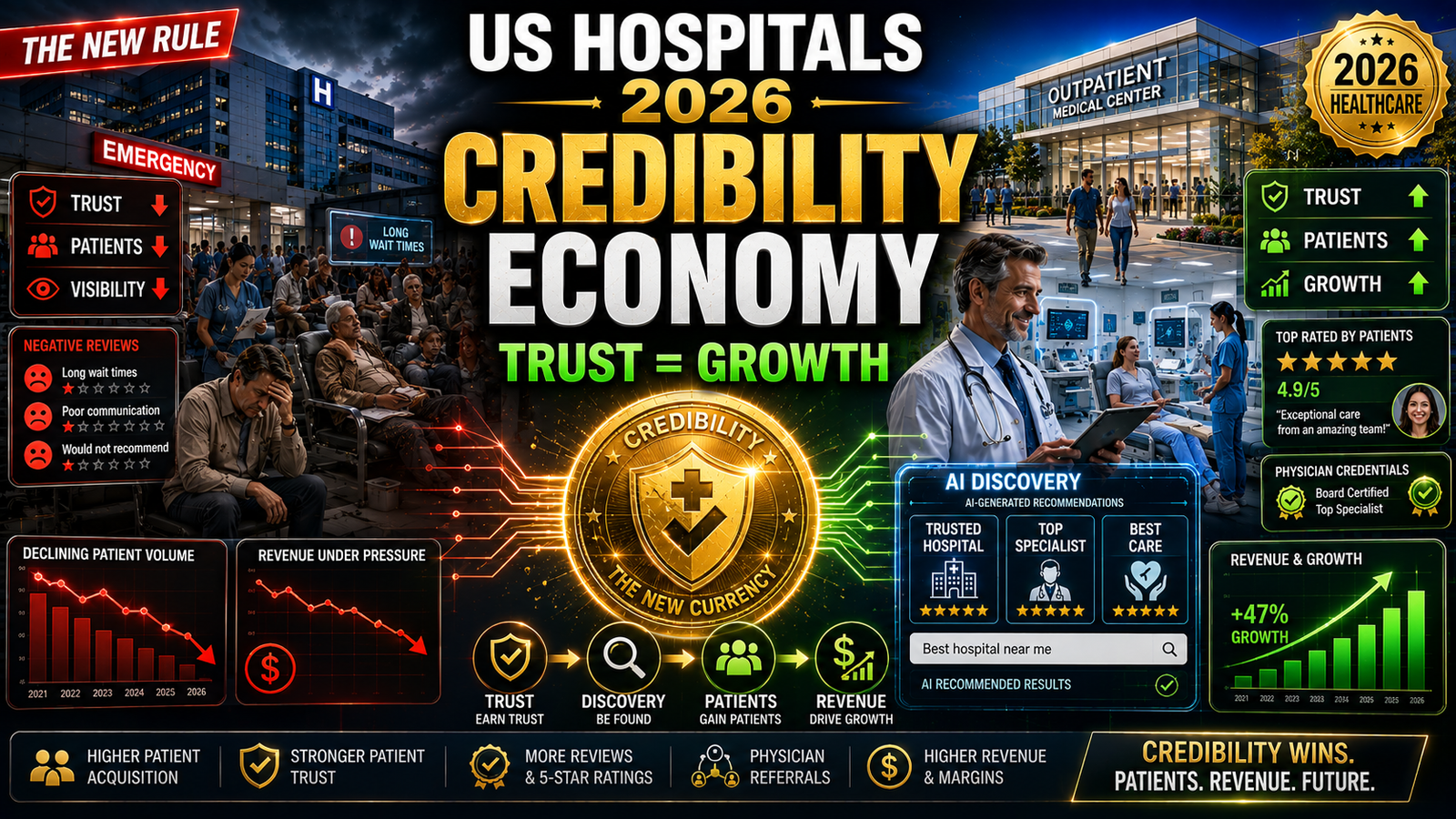
- Credibility is the new currency. Generalist health sites are being penalized; systems investing in expert-reviewed, structured content earn AI citations and patient trust.
- Quantify policy exposure. Rating agencies and boards are asking: What’s your Medicaid hit? What’s your mitigation plan?
Conclusion
The US hospital industry in 2026 is navigating structural pressures that are reshaping competition: a K-shaped recovery widening the gap between winners and losers, a $3.9 billion ASC consolidation wave , $510 billion in Medicaid cuts beyond statutory intent , and a patient discovery layer increasingly dominated by AI answer engines .
The for-profit speed gap is clear. Tenet, CHS, and HCA are deploying outpatient capital at scale while many NFP systems remain in the planning phase .
For hospital marketing and SEO professionals, the mandate is clear: every patient who finds you online is a patient your competitors cannot see. The hospitals that invest in structured, expert-reviewed content, technical excellence, and AI-optimized visibility will capture patients in a system where demand outpaces supply. In an era of AI-mediated discovery, credibility is not just a marketing tactic—it is a survival strategy.