sharmaanubhav6660@gmail.com
Part One: The Financial Reality of 2026
A K-Shaped Recovery
The US hospital industry is experiencing what analysts describe as a “K-shaped” recovery, where financially strong hospitals thrive while weaker institutions continue to struggle. After years of gradual financial improvement following the pandemic, “the tone for the sector has turned more cautious,” according to a Fitch Ratings analysis. “The current operational recovery may be at or very near a transition point” .
The financial divergence is stark. AA-rated hospital systems saw median operating margins improve to 2.8% in fiscal 2025, near pre-pandemic levels, while junk-rated hospitals saw their margins fall to -2.8% from -1.6% the prior year. Strong gains in hospitals’ investment portfolios drove record cash-to-debt ratios, but this was “almost entirely an upper-tier phenomenon.” BBB and junk-rated systems reported sharp declines in cash holdings, with days cash on hand falling 22% and 31% respectively .
This divergence reflects decades of consolidation and the attrition of weaker credits. Fitch’s rated portfolio is concentrated at the higher end, with over three-quarters in AA or A categories—a signal that weaker providers are being systematically filtered out of the sector .
The Outpatient Surge
Broad revenue growth opened 2026, with U.S. hospital net operating revenue rising 5% per calendar day in the first quarter compared to the previous year, and gross operating revenue growing 7% .
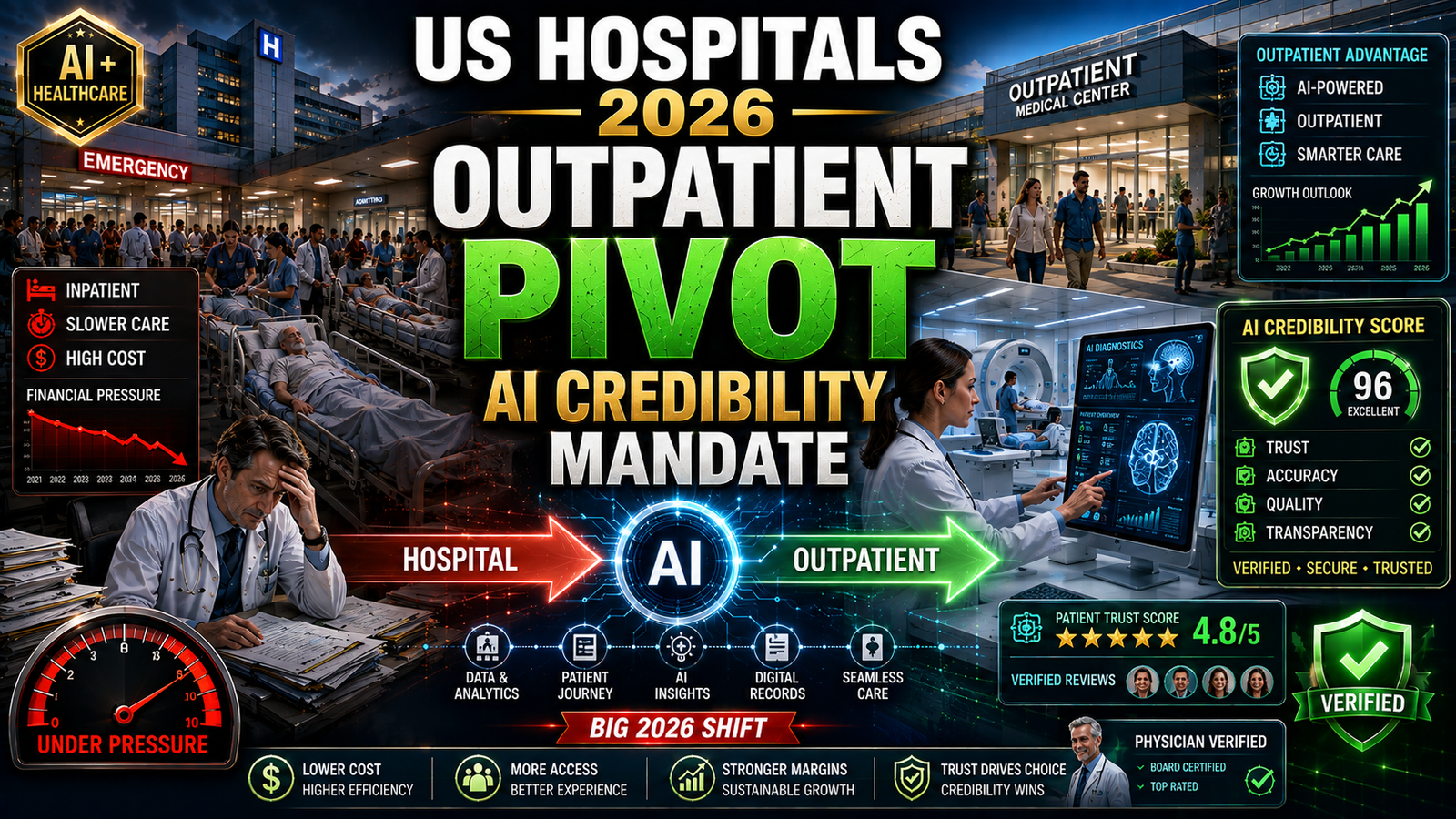
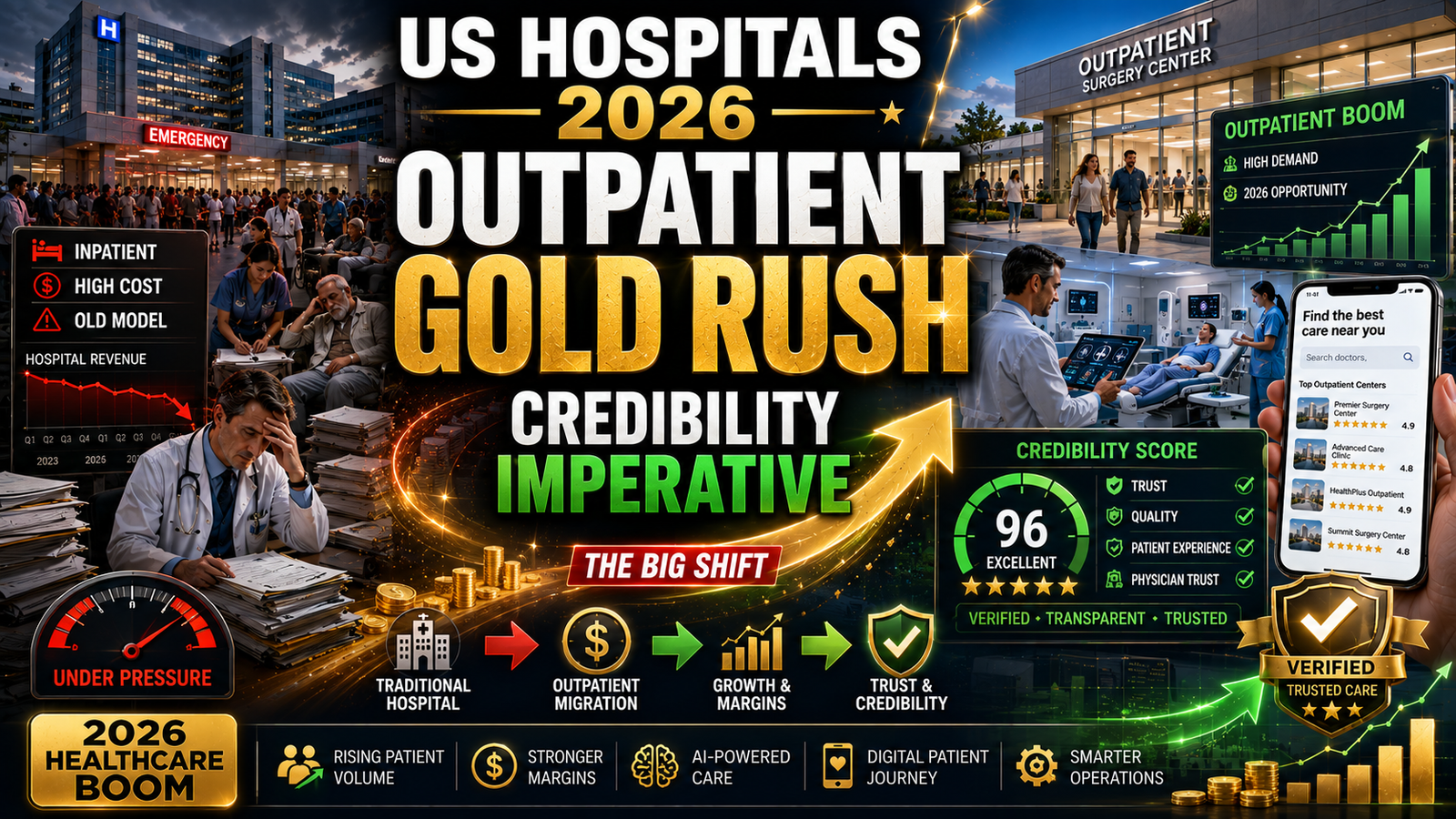
Outpatient care was the clear driver. Outpatient revenue grew 8% nationally, outpacing inpatient revenue (4%) in every region and nearly every bed-size category nationwide . Regional performance varied dramatically:
- Western hospitals led all regions with outpatient revenue surging 13%
- Southern hospitals posted 9% outpatient revenue growth
- Midwest hospitals posted the most modest gains, with outpatient revenue up just 5%
Hospitals in the 200–299 bed range led all size segments: net operating revenue up 8%, inpatient revenue up 7%, and outpatient revenue up 10%. By contrast, the smallest hospitals (0–25 beds) recorded inpatient revenue declining 2%, even as outpatient revenue grew 4% .
Erik Swanson, managing director at Kaufman Hall, summarized the predicament: “Hospitals are off to a relatively soft start in 2026. Outpatient care strategies offer a potential path forward, though hospitals must manage both revenue dilution and a greater concentration of high-acuity patients as a result” .
Hospitals Without an Outpatient Footprint Will Struggle
The migration toward outpatient care is accelerating one of healthcare’s biggest strategic shifts: investment in ambulatory surgery centers. Through May 2026, outpatient revenue per calendar day increased 8% year over year, outpacing inpatient revenue growth of 5%. Meanwhile, adjusted patient days rose 1% while inpatient discharges remained relatively flat .
The financial backdrop is challenging. Through May, operating revenue increased 6% year over year, but total expense climbed 7%. Labor expense rose 4%, while nonlabor expense increased 9%, reflecting continued inflationary pressures .
Kaufman Hall analysts wrote: “Traditional hospital care delivery is fundamentally shifting. As outpatient growth continues year-over-year in May, health systems may consider proactively adapting portfolios and operations to support the future of U.S. healthcare delivery” .
“With some data suggesting a lingering ‘new normal’ for hospitals, healthcare organizations need to be very strategic about diversifying services and managing expenses to build financial stability,” Swanson said. “Demand in outpatient services is on the rise, and hospitals without an outpatient footprint will struggle” .
Part Two: The Policy Storm
The OBBBA Medicaid Cuts
The dominant near-term threat to hospital credit profiles is the One Big Beautiful Bill Act (H.R. 1), which became law in 2025. Direct revenue impacts will stem from reductions starting in FY28 to provider tax contributions and state-directed payments .
Rating agencies are asking health systems to quantify their exposure. “What’s your hit, what’s your exposure? It’s $10 million, it’s $100 million, it’s a billion dollars. Give me a number, and then give me those mitigants that you’ve got to work for it,” said Kevin Holloran, senior director at Fitch Ratings .
CMS has proposed rule changes implementing provisions of the OBBBA that go beyond the statutory language Congress approved. AAP leaders warned the changes will have “an especially devastating impact on children’s hospitals, clinicians and hospitals in rural areas, and pediatricians already operating on razor-thin margins” . State-directed payments, used by children’s hospitals and rural facilities to address low base Medicaid payment rates, are directly targeted .
602 Hospitals at Risk
The impact of combined federal cuts could be devastating. National Nurses United projected that 602 financially vulnerable hospitals could see their combined deficit grow 50% to 75% under the combined weight of Medicare sequestration, Medicaid cuts tied to HR 1, and the expiration of enhanced ACA marketplace subsidies .
Those 602 hospitals already carry a combined $10.16 billion deficit. The new cuts could add $5.21 billion to $7.72 billion in a single year once fully phased in . The losses would be widespread: the median projected loss per hospital is $3.4 million to $4.7 million, while a small number of larger hospitals face losses as high as $180 million to $316 million .
Notably, 61% of the vulnerable hospitals are in metropolitan areas, challenging the assumption that financial distress is mainly a rural issue .
Demographic Pressures
Over the next four years, approximately 11,000 baby boomers will turn 65 each day, simultaneously driving up demand for more advanced medical care and drawing skilled labor out of the workforce . Hospitals are responding with capital spending that rose to the highest level since 2008, with about $29.2 billion in muni bonds issued year-to-date .
Part Three: The Strategic Response
The ASC Land Grab
Health systems, private equity firms, and payers are racing to acquire outpatient assets, particularly ASCs. Physician medical groups accounted for a record 46% of all healthcare transactions in the first quarter of 2026 .
The scale of consolidation is dramatic. Ascension completed its $3.9 billion acquisition of AmSurg, expanding its ASC network to roughly 300 facilities nationwide. Amber Sims, Ascension’s executive vice president and chief strategy and growth officer, explained: “We had to get ahead in the ambulatory business, because that’s where care is going. It’s where patients want to receive care, where payers want to seek care, and where providers want to provide care” .
Other systems are following. Cleveland Clinic partnered with Regent Surgical to develop ASCs in several markets. Bon Secours Mercy Health teamed with Compass Surgical Partners to develop more than 30 ASCs. ChristianaCare and Atlas Healthcare Partners formed a joint venture for an ASC network .
The strategy is about more than following patients into outpatient care. Owning or partnering with ASCs can increase reimbursement rates, strengthen physician alignment, capture downstream referrals, and shift procedures into lower-cost settings .
The Asset-Light, Return-Rich Strategy
“Executives are asking, ‘Where can I get the best return when I invest my capital?'” Holloran said. “By capital, it’s physical capital, but it’s also mental capital in terms of people and focus. They want a light investment for good-sized returns. We’re seeing a renewed flight to the ambulatory and outpatient space because it’s far cheaper to build and operate there, with a much better return. So, asset-light, return-rich” .
Cleveland Clinic is aggressively investing in ambulatory and outpatient care, with more than half of patient care revenue already coming from outpatient services. Yet the system continues to invest in inpatient services for complex care—a balanced portfolio approach .
“The industry is likely to shift from trifurcation to bifurcation over the next three years,” Holloran predicted. He anticipates a division between “have” and “have-not” hospitals based on location, willingness to make hard decisions, and ability to realize operational opportunities .
Part Four: The Marketing Imperative: GEO for Healthcare
From SEO to GEO
Generative engine optimization (GEO) is the practice of structuring medical content so AI search engines cite it accurately when patients ask health questions . The shift is measurable: AI search visits grew 42.8% year over year, rising from 15.6 billion in Q1 2025 to 27.4 billion in Q1 2026 .
Health systems that rely only on classic SEO are now optimizing for a channel that grows far slower than the one patients are adopting. The patient journey has moved upstream: many people now ask an AI assistant to explain a diagnosis or compare treatment options before they ever contact a provider .
How AI Engines Pick Sources
AI engines reward content that is structured, sourced, and verifiable. Evidence matters more than tone: adding statistics increased AI visibility by 22%, and adding quotations raised it by 37% . Cited text is nearly twice as likely to contain definitive language, 36.2% versus 20.3% .
Key GEO tactics include:
- Expert-reviewed content: Every clinical page should name the reviewing physician, list credentials, show a review date, and link to current medical literature .
- Place answers high: 44.2% of ChatGPT citations come from the first 30% of page text .
- Structure pages for extraction: Tables get extracted by LLMs at 81% versus 23% for prose .
- Freshness matters: 65% of AI bot hits target content published within the past year .
Structured Data as Foundation
AI needs structured, predictable content to trust and cite. This means consistent formatting: star ratings, provider names, visit dates, and relevant keywords, all organized with schema markup .
“Without schema markup, AI sees a review that says ‘5 stars for Dr. Evans!’ and has to guess: ‘Which Dr. Evans? At which clinic? For what specialty?'” . With schema markup, you’re telling AI exactly who, where, and what—making it easy for AI to confidently recommend your practice.
The For-Profit Speed Gap
The four largest publicly traded hospital companies—HCA, Tenet, UHS, and Community Health Systems—are deploying outpatient capital at pace:
- Tenet Healthcare deployed $125 million in Q1 2026 to acquire seven ASCs, representing half of its annual M&A target for USPI .
- Community Health Systems is purchasing ASC operators, opening de novo facilities, and acquiring major surgery centers .
- HCA continued outpatient acquisitions in urgent care, ASC, and freestanding ED platforms .
The takeaway is clear: high-acuity surgical work is migrating outpatient at scale, and multispecialty ASCs in growth markets are the highest-margin growth vehicle available.
Conclusion
The US hospital industry in 2026 is navigating structural pressures that are reshaping the competitive landscape: a K-shaped recovery widening the gap between winners and losers, $1 trillion in Medicaid cuts putting 602 hospitals at risk, a massive outpatient consolidation wave, and a patient discovery layer increasingly dominated by AI answer engines.
For hospital marketing and SEO professionals, the mandate is clear: every patient who finds you online is a patient your competitors cannot see. The hospitals that invest in structured, expert-reviewed content, technical excellence, and AI-optimized visibility will capture patients in a system where demand outpaces supply. In an era of AI-mediated discovery, credibility is not just a marketing tactic—it is a survival strategy.