sharmaanubhav6660@gmail.com
Part One: The Financial Landscape
A K-Shaped Divergence
The US hospital sector in 2026 is experiencing a “K-shaped” recovery, where financially strong institutions thrive while weaker ones decline. This divergence reflects decades of consolidation and the attrition of weaker credits in the sector. AA-rated hospital systems saw median operating margins improve to 2.8% in fiscal 2025, near pre-pandemic levels, while junk-rated hospitals saw their margins fall to -2.8% from -1.6% the prior year.
Strong gains in hospitals’ investment portfolios drove record cash-to-debt ratios, but this was “almost entirely an upper-tier phenomenon.” BBB and junk-rated systems reported sharp declines in cash holdings, with days cash on hand falling 22% and 31% respectively compared to fiscal year 2022.
Q1 2026 Financial Performance
Hospital finances stabilized in February after a weak start to 2026, but the year-to-date operating margin index stood at 1.9%, considerably below the 3.7% margin posted at the end of 2025. Net operating revenue rose 5% per calendar day compared to the previous year, with gross operating revenue growing 7%.
Bad debt and charity care climbed 8% year-over-year, while patient volumes dropped across inpatient, outpatient, and emergency care settings. Discharges fell 2%, emergency department visits dropped 5%, and total costs per calendar day increased 5%—with supply costs up 5%, drug expenses rising 7%, and labor costs climbing another 5%.
Non-labor expenses jumped 7% monthly and yearly on a per-calendar-day basis, with supply costs up 5% and purchased service expenses up 9%. The gap between gross and net operating revenue continued to widen, reflecting the difference between what hospitals bill and what they ultimately collect.
Regional and Size Variations
Regional performance varied dramatically. Western hospitals led all regions, with outpatient revenue surging 13%. Southern hospitals posted 9% outpatient revenue growth and the highest inpatient growth at 5%. Midwest hospitals posted the most modest gains, with outpatient revenue up just 5%.
Hospitals in the 200–299 bed range led all size segments: net operating revenue up 8%, inpatient revenue up 7%, and outpatient revenue up 10%. The smallest hospitals (0–25 beds) recorded inpatient revenue declining 2%, even as outpatient revenue grew 4%.
The data points to a two-speed hospital economy: mid-size facilities in growth regions are accelerating, while the smallest hospitals face inpatient contraction even amid a broadly favorable revenue environment.
The Outpatient Surge
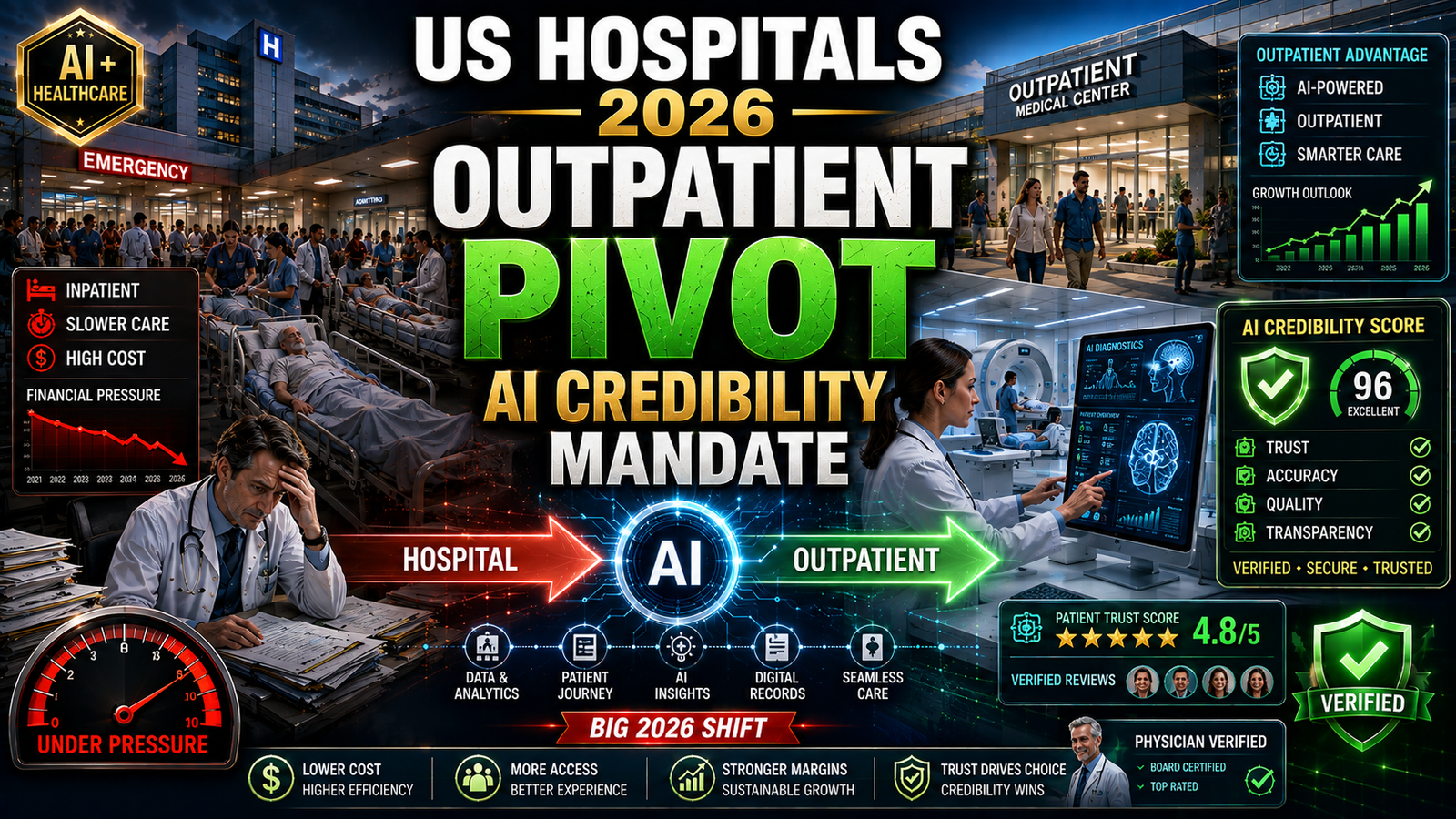
Outpatient care was the clearest driver of revenue growth in early 2026. Outpatient revenue grew 8% nationally, outpacing inpatient revenue (4%) in every region and nearly every bed-size category nationwide. Outpatient revenue increased 11.8% year-over-year in March, outpacing inpatient revenue growth of 6.6%. Outpatient visits rose 7.3% compared to a 3.1% increase in inpatient admissions.
However, the outpatient shift comes with tradeoffs. As more care moves to outpatient settings, hospitals face revenue dilution and a higher concentration of complex, high-acuity patients on the inpatient side. Volume trends reinforce this dynamic: discharges per calendar day fell 2%, adjusted patient days declined 1%, average length of stay dropped 4%, and emergency department visits decreased 5%.
Erik Swanson, managing director at Kaufman Hall, summarized the predicament: “Hospitals are off to a relatively soft start in 2026. Outpatient care strategies offer a potential path forward, though hospitals must manage both revenue dilution and a greater concentration of high-acuity patients as a result.”
“Demand in outpatient services is on the rise, and hospitals without an outpatient footprint will struggle,” Swanson added.
Part Two: The Policy Storm
The One Big Beautiful Bill Act
The dominant near-term threat to hospital credit profiles is the One Big Beautiful Bill Act (H.R. 1), which became law in 2025. The law imposes new work requirements for Medicaid recipients, limits hospital funding sources like state-directed payments, and could result in more than 10 million individuals losing insurance coverage.
Projected federal Medicaid funding reductions of nearly $1 trillion over the next decade represent one of the most significant proposed reductions to the program in decades. Direct revenue impacts will stem from reductions starting in FY28 to provider tax contributions and state-directed payments (SDPs).
CMS Proposed Rule Changes
CMS has proposed rule changes implementing provisions of the OBBBA that go beyond the statutory language Congress approved. The changes include capping certain state-directed payment arrangements at 100% of Medicare rates in expansion states, a policy that would reduce spending by more than $775 billion over 10 years.
The American Hospital Association warned that the changes will have “very real consequences for access to care in communities across the nation,” adding: “When hospitals and providers are forced to reduce services—or even close entirely—everyone in a community is impacted.”
AAP leaders warned the changes will have “an especially devastating impact on children’s hospitals, clinicians and hospitals in rural areas, and pediatricians already operating on razor-thin margins.”
602 Hospitals at Risk
National Nurses United projected that 602 financially vulnerable hospitals could see their combined deficit grow 50% to 75% under the combined weight of Medicare sequestration, Medicaid cuts tied to HR 1, and the expiration of enhanced ACA marketplace subsidies. Those 602 hospitals already carry a combined $10.16 billion deficit, and the new cuts could add $5.21 billion to $7.72 billion in a single year once fully phased in.
The losses would be widespread: the median projected loss per hospital is $3.4 million to $4.7 million, while a small number of larger hospitals face losses as high as $180 million to $316 million. Notably, 61% of the vulnerable hospitals are in metropolitan areas, challenging the assumption that financial distress is mainly a rural issue.
Specific Health System Impacts
Specific health systems have projected devastating losses. Alameda Health System will lose more than $100 million annually by 2030 and has laid off nearly 300 employees. Trinity Health projects $1.5 billion in losses and has already cut 10.5% of its billing staff, closing the maternity unit at one of its Georgia hospitals.
HCA expects to lose up to $900 million this year due to subsidy rollbacks, while Tenet projects a $250 million hit. UHS estimated $432 million to $480 million in annual Medicaid revenue reductions by 2032.
Political and Public Response
The mood in Washington has shifted as the consequences of the cuts have become tangible. More than 100 House Republicans wrote a letter to Speaker Johnson outlining their specific concerns with the extent and speed of the Medicaid cuts. The letter, signed by 108 members, warned that the cuts would threaten patient access and urged the administration to address “federal policies that negatively impact the patients we represent and the hospitals that care for them.”
Public sentiment is also shifting. A Pew Research Center survey found that 60% of Americans believe the federal government has a responsibility to ensure access to healthcare, and a Kaiser Family Foundation tracking poll found that 63% of voters oppose Medicaid cuts. Advocacy groups are mobilizing, with the American Hospital Association, American Medical Association, and other stakeholders launching coordinated campaigns to highlight the impact of the cuts.
Part Three: The Strategic Response
The Asset-Light, Return-Rich Strategy
Hospital executives are increasingly asking: “Where can I get the best return when I invest my capital?” The answer increasingly is the ambulatory and outpatient space because “it’s far cheaper to build and operate there, with a much better return.”
“Executives are asking, ‘Where can I get the best return when I invest my capital?’ By capital, it’s physical capital, but it’s also mental capital in terms of people and focus. They want a light investment for good-sized returns. We’re seeing a renewed flight to the ambulatory and outpatient space because it’s far cheaper to build and operate there, with a much better return. So, asset-light, return-rich,” said Kevin Holloran, senior director at Fitch Ratings.
Cleveland Clinic is aggressively investing in ambulatory and outpatient care, with more than half of patient care revenue already coming from outpatient services. Yet the system continues to invest in inpatient services for complex care—a balanced portfolio approach.
The ASC Land Grab
The scale of consolidation is dramatic. Ascension completed its $3.9 billion acquisition of AmSurg, expanding its ASC network to roughly 300 facilities nationwide. The FTC required seven divestitures before approving the transaction—the first time regulators applied that level of scrutiny to an ASC-specific deal. Ascension itself went from running 139 hospitals in 2022 to operating 90 hospitals and more than 300 ASCs by June 2026.
Amber Sims, Ascension’s executive vice president and chief strategy and growth officer, explained: “We had to get ahead in the ambulatory business, because that’s where care is going. It’s where patients want to receive care, where payers want to seek care, and where providers want to provide care.”
Other systems are following. Cleveland Clinic partnered with Regent Surgical to develop ASCs in several markets. Bon Secours Mercy Health teamed with Compass Surgical Partners to develop more than 30 ASCs. ChristianaCare and Atlas Healthcare Partners formed a joint venture for an ASC network. More than 60% of health system executives identify ASCs as a primary growth interest.
The For-Profit Speed Gap
The four largest publicly traded hospital companies—HCA, Tenet, UHS, and Community Health Systems—are deploying outpatient capital at pace:
- Tenet Healthcare deployed $125 million in Q1 2026 to acquire seven ASCs, representing half of its annual M&A target for USPI, which now operates nearly 570 assets.
- Community Health Systems is purchasing a majority stake in an ASC operator in Anchorage, opening de novo ASCs in Alabama, and acquiring the Surgical Institute of Alabama.
- HCA continued outpatient acquisitions in urgent care, ASC, and freestanding ED platforms.
The takeaway is clear: high-acuity surgical work is migrating outpatient at scale, and multispecialty ASCs in growth markets are the highest-margin growth vehicle available.
The Divergence of Competencies
“The industry is likely to shift from trifurcation to bifurcation over the next three years,” Holloran predicted. He anticipates a division between “have” and “have-not” hospitals based on location, willingness to make hard decisions, and ability to realize operational opportunities.
Part Four: The Marketing Imperative
The Shift to Outpatient-Heavy Revenue Models
Major health systems are preemptively shifting toward outpatient-heavy revenue models. Health systems are decoupling outpatient facilities and ASCs from central hospital overhead, recognizing the margin advantages of the outpatient setting.
For hospital marketing and SEO professionals, this structural shift creates a clear mandate: every outpatient location needs a robust content strategy. Each clinic, ASC, and practice location needs a dedicated landing page with specific services, local phone numbers, embedded Google Maps, and parking information.
The GEO Imperative
Patients increasingly use AI search and chatbots to find health information. AI search visits grew 42.8% year-over-year, rising from 15.6 billion in Q1 2025 to 27.4 billion in Q1 2026. Health systems that rely only on classic SEO are now optimizing for a channel that grows far slower than the one patients are adopting.
The American Hospital Association’s 2026 Annual Meeting features a session titled “Winning the AI Recommendation: Connecting Hospital Brands and Doctors in the GEO Era.” The session emphasizes that for decades, the “Digital Front Door” was your website. In 2026, that door has moved to the AI interface.
Expert-Reviewed Content
Expert review is the foundation of healthcare GEO. Every clinical page should name the reviewing physician, list credentials, show a review date, and link to current medical literature. These signals tell AI engines the content is accountable and protect patients from inheriting errors.
The YMYL (Your Money or Your Life) trust architecture has four layers: credentialed authorship, clinical citation density, healthcare schema confirmation, and cross-platform consistency.
Technical SEO and Schema
AI needs structured, predictable content to trust and cite. This means consistent formatting: star ratings, provider names, visit dates, and relevant keywords, all organized with schema markup. Add medical schema markup—MedicalOrganization, Physician, MedicalCondition, and FAQPage—so AI engines can parse authorship, conditions, and procedures without guessing.
Credibility Is the New Currency
As Ashley Pollard, vice president of marketing at SSM Health, captured the shift: “The traditional model where consumers ask Google a question and navigate multiple websites for answers is becoming obsolete. As AI evaluates every digital touchpoint, a holistic focus on the quality, credibility and structure of our content across the entire digital ecosystem is no longer optional—it is essential.”
Conclusion
The US hospital industry in 2026 is navigating structural pressures that are reshaping competition: a K-shaped recovery widening the gap between winners and losers, $1 trillion in Medicaid cuts putting 602 hospitals at risk, a massive outpatient consolidation wave, and a patient discovery layer increasingly dominated by AI answer engines.
For hospital marketing and SEO professionals, the mandate is clear: every patient who finds you online is a patient your competitors cannot see. The hospitals that invest in structured, expert-reviewed content, technical excellence, and AI-optimized visibility will capture patients in a system where demand outpaces supply. In an era of AI-mediated discovery, credibility is not just a marketing tactic—it is a survival strategy.